Zahedan Maccare: A Stark Reminder of Iran’s Ongoing Repression of the Baloch People
LONDON: A pamphlet released by the Free Balochistan Movement (FBM) has drawn renewed international attention to the ongoing and systematic oppression of the Baloch people in Iranian-occupied Balochistan, focusing particularly on the massacre known as “Bloody Friday or Zahedan Massacre” which took place in Zahedan on September 30, 2022.
According to the FBM, the purpose of the publication is to highlight the historical and continuing acts of Baloch genocide carried out by the Iranian state over the past century. The pamphlet describes the Bloody Friday incident as one of the most organised and brutal chapters of this oppression.
On that day, shortly after Friday prayers at the Makki Mosque in Zahedan, Iranian security forces opened indiscriminate fire on peaceful Baloch protesters. The assault resulted in the deaths of over a hundred of unarmed civilians and left hundreds more wounded. Baloch political and civil groups have since commemorated the tragedy as “Bloody Friday” or “Jumma-e-Khooni,” which they describe not as an isolated event, but as a clear continuation of long-standing policies aimed at the destruction of the Baloch nation.
The protest in Zahedan that led to the massacre was triggered by the rape of a 15-year-old Baloch girl, Mahoo Baloch, by an Iranian security official. According to the pamphlet, the incident is a glaring violation of basic human rights and international law. However, in the context of colonial occupation, where the identity of an entire ethnic group is criminalised and decision-making power is denied, the pamphlet argues that even the pursuit of justice becomes a dangerous and uncertain endeavour.
The Free Balochistan Movement accused the Iranian state of using colonial tactics to silence dissent. The pamphlet outlines that thousands of Baloch youth have been executed under allegations of drug trafficking, while political and human rights activists are frequently abducted and disappeared in the name of national security. It also highlights the plight of Baloch fuel traders—known as “Zukhtbaran”—who are often burned alive along with their vehicles while attempting to earn a livelihood. These atrocities, the pamphlet notes, have been condemned by international human rights organisations such as Amnesty International and Human Rights Watch, yet Iran continues its policies unabated.
Economic exploitation and cultural erasure are also key concerns raised by the FBM. Despite being rich in natural resources and strategically located, Balochistan remains one of the most underdeveloped and marginalised regions. The pamphlet highlights that Iran has pursued a colonial model in Balochistan, extracting resources for the benefit of Tehran while depriving the Baloch people of economic, educational, and healthcare opportunities. Moreover, there is a systematic attempt to erase Baloch cultural identity by imposing Persian language and non-Baloch cultural norms. The pamphlet argues that non-Baloch populations, including Gujars [Persians], are being settled in the region to change its demographic composition and reduce the Baloch to a minority in their own land.
The FBM emphasised that the Baloch people have a long and proud history of resistance against foreign occupation. From the uprisings of Baloch chieftains to the movements led by student revolutionaries and the current generation’s struggle, Baloch resistance has persisted across generations. The Bloody Friday massacre is seen as yet another chapter in this history of defiance, where even a mosque was not spared, and innocent civilians were turned into targets of state violence.
The pamphlet also criticises the international community for its silence on Iran’s actions in Balochistan. It argues that institutions such as the United Nations, the European Union, and the Organization of Islamic Cooperation have failed to speak out against the ‘campaign of Baloch genocide’. According to the FBM, this silence amounts to complicity and emboldens the Iranian state to continue its repressive policies without fear of accountability.
The Free Balochistan Movement concludes that the Iranian state is a colonial occupying power in Balochistan, and that the only solution is complete independence and national sovereignty for the Baloch people. The organisation rejects calls for reform or limited autonomy, arguing that true justice can only be achieved when the Baloch have full control over their land, resources, identity, and future.
The FBM emphasises the importance of unity, principles, and adherence to the goals of the national liberation movement. It warns that deviation from these principles leads to division and ultimately failure. The pamphlet closes with a powerful message: the Bloody Friday massacre is not just a memory, but a reminder that freedom is not a luxury—it is a necessity. As long as the Baloch people remain deprived of their basic rights, their very existence is at risk.
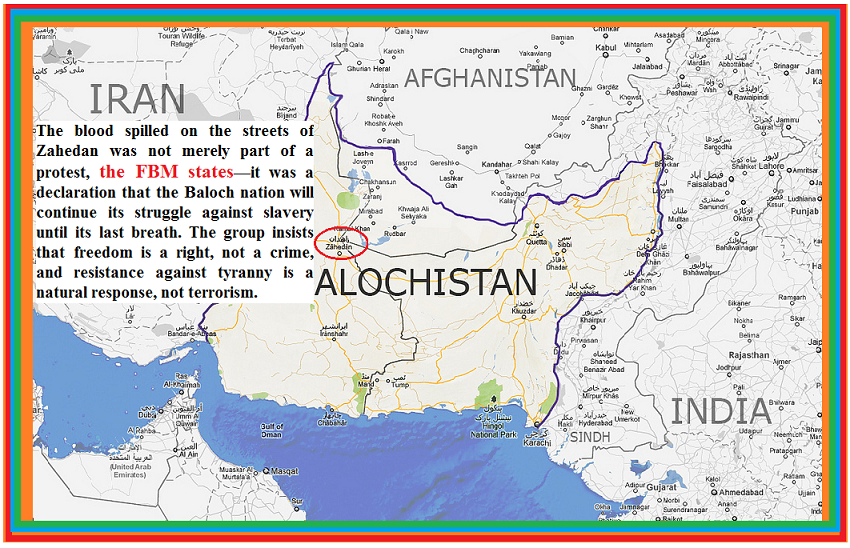
The blood spilled on the streets of Zahedan was not merely part of a protest, the FBM states—it was a declaration that the Baloch nation will continue its struggle against slavery until its last breath. The group insists that freedom is a right, not a crime, and resistance against tyranny is a natural response, not terrorism.