Balochistan: Iranian Soldiers Assault Two Elderly Baloch Women: Citizens Demand Justice and Public Accountability
DOZZAAP (ZAHEDAN): A viral video showing the violent assault of two elderly Baloch women by Iranian military forces at the Milak border terminal in Hirmand County, Iranian Occupied Balochistan, has sparked a wave of outrage and drawn renewed attention to the systemic mistreatment of Baloch citizens by Iranian state forces.
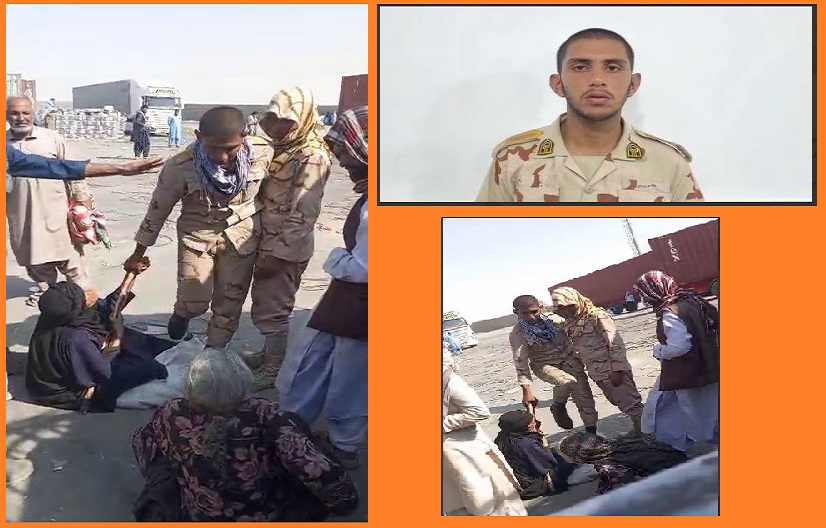
The incident, which occurred on Thursday, October 23, 2025, involved two women who, according to local sources, were attempting to sell a small quantity of fuel to earn money for their daily living expenses. The women were reportedly carrying two 1.5-liter bottles of gasoline when military personnel stationed at the border stopped them, insulted them with degrading language and violently beat them in public view.
The video, filmed by bystanders and shared widely online, shows the women being kicked and struck while pleading for mercy. Within hours of its release, the footage provoked widespread condemnation from citizens, activists, and human rights organisations, who described the act as “inhumane,” “humiliating,” and a blatant violation of human dignity.
In the face of mounting public anger, the prosecutor of Hirmand County announced that the conscript soldier involved and his immediate commander had been arrested and referred to the military prosecutor’s office for investigation.
Despite the official announcement, the arrests failed to appease the public. Thousands of users on social media demanded that the trial and punishment be conducted openly and transparently, accusing the authorities of routinely concealing abuses committed by members of the security forces. Many argued that temporary arrests or private proceedings would not restore public trust, calling instead for a public and exemplary punishment as a deterrent to future abuses.
Local witnesses have said that incidents like this are not isolated but part of a long-standing pattern of violence and humiliation faced by impoverished Baloch residents in border regions. Fuel smuggling is one of the few means of subsistence available to many families in Balochistan. Those who engage in small-scale fuel trading, known locally as Sokhtbar or Koolbar, often risk their lives crossing the border to sell just a few litres of fuel, while large-scale smuggling routes are reportedly controlled by well-connected criminal networks with ties to Iran military and security institutions.
The incident has drawn sharp criticism from across Baloch society. The young members of the Mohammadzehi tribe issued a statement condemning the attack, calling it an insult to the honour of all Baloch people. “Every Baloch woman is a mother to all Baloch youth,” the statement read, warning that the community’s patience should not be mistaken for weakness and urging tribal leaders and religious scholars to take swift action. The statement emphasised that Baloch youth “seek action, not words.”
Following the backlash, the conscript soldier appeared in a video apology, expressing remorse for his actions. In the video, he claims that he “lost control” and did not intend to disrespect the women.
However, his apology did little to ease the anger of citizens, who saw it as an attempt to deflect accountability. Many activists described the apology as coerced and symbolic, pointing out that similar incidents in the past have ended without meaningful justice or reform.
Human rights advocates have called the assault a clear violation of Iran’s own Charter of Citizens’ Rights and international human rights obligations. They argue that the event exposes a structural inequality deeply embedded in the country’s governance of its border regions, where Baloch citizens are disproportionately targeted by security crackdowns while suffering from chronic unemployment, underdevelopment and neglect.
The continued public outrage reflects growing frustration with the “double standard” in state policy, where poverty and survival efforts are criminalised but corruption, discrimination, and organised smuggling networks operate with impunity. For many, the assault on the two elderly women has become a symbol of both the everyday injustice and the entrenched inequality that define life in Iranian Occupied Balochistan.