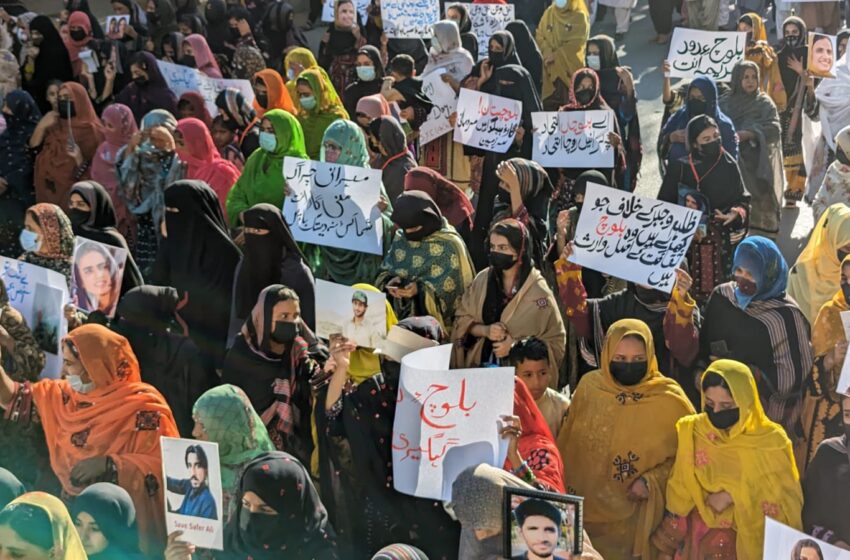
Photo: BYC Social Media
A day for elimination of violence against women: The case of Baloch women
By Edele Baloch
Rafael Trujillo, a dictator of Dominican Republic, never thought the day of 25th November to be observed after assassinating the Mirabal sisters on 25th November, 1960. Since then, every year, on 25th November, the world comes together to highlight and mark the International Day for the Elimination of Violence against Women.
The day puts forward the concept of a day to encourage the world, women in particular, to confront the forces that abuse and discriminate against the women. Though the world is becoming more balanced emphasizing on gender equality, the violence against women still exist which is usually labelled as a structural injustice.
This day is all about the voices of women who face violence, about the survivors and ones whose voices are never heard. The world, including such voices, comes together to speak to end the violence against the women, more importantly the women living in conflict zones, because according to the United Nations Regional Informational Centre (UNRIC) women living in conflict zones and militarized areas are mostly affected and are victim of violence.
When in 2000 the United Nations official declared this day as the International Day for the Elimination of Violence against women, the world powers came together with the purpose of eliminating all forms of violence on women. Since then, several campaigns have been launched and supported by international organization and world powers such as the European Union. The issue is so intense that theme includes 16 days activism against gender-based violence. The history of this day is very lengthy and the list of campaigns associated with this day is very long. The progress since the announcements of all campaigns remains very slow, eliminating violence against women only by 0.2%.
Today, the forms of violence have changed. Women all around the world are victim of different types of violence. According to WHO the most common actors are intimate partners, family members, relatives. Besides this, women also become victim of violence by state and non-state actors as well in some of the countries, but the case with the women of Balochistan, as documented, seems to be different and the forms of violence have unique patterns.
The state remains the most significant and regular actor of violence by harassing, pressuring to spy on families and using women as a tool to control male family members and relatives. For example, Najma Baloch D/o Dilsard, from Geshkaur Awaran, ended her life after being pressured to spy, harassed and blackmailed repeatedly by Military Intelligence. Similarly, a tragic event took place in Kharan, where a female named Amirzadi finally in November, 2025 committed suicide after her house was raided multiple times by Pakistani Army.
The Baloch Warna News reported that on 19th September, 2025, the military aggression resulted the death of two women. Further reports also show that the state has also utilized its sponsored death squads and representative to continue its violence against women. These reports include the incident of Barkhan, Balochistan, where women were kept captives, raped and shot dead. The accused in this case, a pro-Pakistan army, Sardar Abdul Rehman Khetran was briefly detained but later released on bail and remains at large. Furthermore, a woman from Khuzdar named Asma Jattak was also a victim of such violence who was abducted by Pakistani Army backed death squads .
These brutal and inhuman acts of Pakistani Army are mainly aimed at pressurising Baloch women to either commit suicide or mentally collapse. Several women such as Noor Jahan Baloch from Hoshab, Balochistan, Adeela Khudabaksh from Turbat, Balochistan, Mahal Baloch and many others have been arrested, tortured and harassed by Pakistani army. These forms of mental violence are adopted by the state to curb the nationalist movements by targeting women with no involvement.
The violence against Baloch women by the state is at the peak of inhumanity and is in continuation for years. Today, number of Baloch women are missing, being detained in torture cell, raped, killed and harassed after the release. Munir Mengal who was detained on 4th April, 2006, witnessed the worst form of violence adopted by Pakistan Army. Munir was ordered to rape a woman who he heard speaking Balochi and praying for her son. When the woman was brought to his torture cell, he got to know that she was Zarina Marri Baloch who was abducted with her son. Such unheard and unreported incidents are in numbers where women have been raped, shot dead, dragged on streets, detained illegally and missing for years.
In the present era of globalisation and digitalisation, everyone is concerned and focused on reporting and reducing the violence against women but the fate of Baloch women remain unchanged. The violence against Baloch women, despite reports and publicly available information, remain unnoticed and under-addressed by international communities. Such structural and symbolic violence against Baloch women needs to be taken seriously as it is perpetually harming the Baloch women.
The act of eliminating violence against women should not be limited just because the perpetrator is a state and its army. The fight against this violence should be free of biasness and the world should make Pakistan and its army accountable for actively detaining, harassing and killing Baloch women. There needs to be stronger calls for condemnation of violence against Baloch women.
Disclaimer: The views and opinions expressed in this article are solely those of the author and do not necessarily reflect the official policy or position of Baloch Warna News. The publication provides a platform for diverse perspectives.