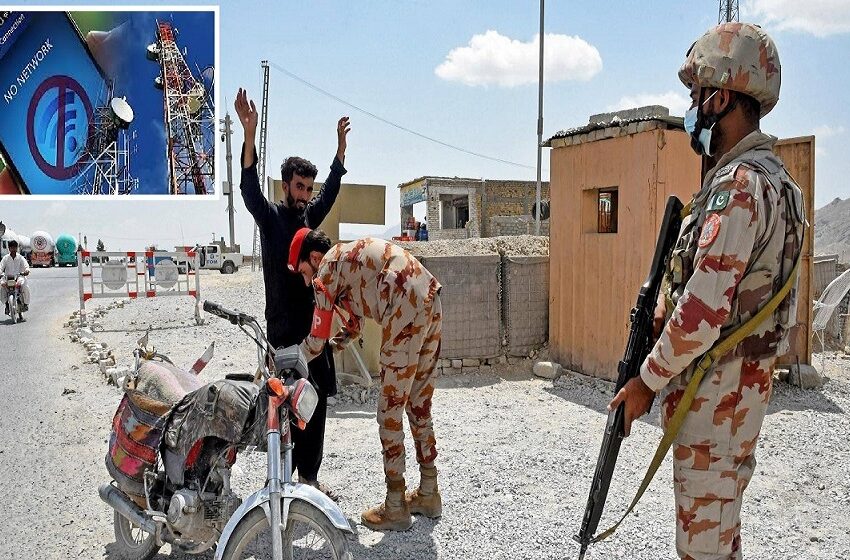
Pakistan suspends internet in Balochistan and imposes Section 144
SHAAL, BALOCHISTAN: The Pakistan army backed ‘Balochistan government’ has imposed a series of security measures in response to escalating security concerns. The measures, which include the suspension of mobile internet services, restrictions on transport services, and a ban on gatherings, are set to remain in place for at least the next two weeks, with possible extensions depending on the security situation.
A notification issued by the Balochistan Home Department on Wednesday confirmed the re-imposition of Section 144 across all districts of Balochistan. The order, which is set to remain effective until November 30, 2025, prohibits gatherings of five or more individuals in public spaces. Face coverings that obstruct identification, such as masks, mufflers, or veils, have also been restricted as part of the government’s efforts to curb potential unrest.
Other significant provisions in the order include a ban on pillion riding on motorcycles, with exceptions made for women, children, and elderly citizens. The use of unregistered motorcycles, tinted windows on vehicles, and the carrying or display of weapons has also been prohibited. Violators of these orders face penalties under Section 188 of the Pakistan Penal Code, which could result in imprisonment for up to six months or fines.
The provincial government announced that mobile internet services would be suspended across all 36 districts of Balochistan from November 10-16, with the exception of Quetta. The suspension, which is aimed at addressing security risks, has caused widespread disruptions in communication, particularly in rural areas where many rely on mobile internet for daily activities.
Despite Quetta being exempt from the outage, citizens in parts of the city have reported intermittent internet connectivity issues, making it difficult for people to access online services. The move follows a pattern of similar disruptions in recent months, including a 24-hour internet shutdown on October 31, also due to security concerns.
The suspension of mobile internet has raised concerns about the broader economic impact. In January 2023, a report revealed that Pakistan led the world in financial losses due to internet shutdowns, with a total cost of $1.62 billion in 2022 alone.
In another significant move, the Balochistan government has temporarily suspended all transport services on the Loralai section of National Highway N-70 due to security concerns. The suspension, which will remain in effect until November 14, 2025, restricts intercity travel, including taxis and private vehicles. However, the ban does not apply to local or intra-city traffic, allowing residents to travel within their own areas for daily needs. The government has also urged citizens to verify official travel advisories before planning any journeys along the route to avoid inconvenience.
As part of the ongoing security measures, all educational institutions in the Cantonment area of Quetta have been closed from November 12-16. While some schools and colleges in other parts of Quetta remain open, the closure of institutions in specific districts has disrupted the educational process for students in affected areas.
Analysts believe that the latest security measures could also be linked to events commemorating Baloch Martyrs Day, observed annually on November 13. The day holds deep historical and emotional significance for the Baloch people, who remember those who sacrificed their lives in the struggle for Balochistan’s freedom. The commemoration dates back to November 13, 1836, when Mir Mehrab Khan, the ruler of Balochistan, fought against invading British imperial forces at his fort in Kalat. Despite being outnumbered and poorly armed, the Khan and his companions resisted until their deaths rather than surrender to the occupiers.
Since then, the Baloch nation has marked this day to honour thousands of fallen heroes who have sacrificed their lives over generations in the ongoing struggle for the freedom of Balochistan, against successive occupying states, including Iran and Pakistan.
The government’s actions are also part of broader efforts to address the worsening security situation in Balochistan, where militant attacks have become increasingly frequent. Pro-freedom militants have ramped up the intensity of their attacks, making it difficult for authorities to maintain peace and stability in the region.
While these measures are aimed at addressing the growing security risks in Balochistan, they also come at a cost to residents who face significant disruptions to their daily lives. Restrictions on internet access, travel, and public gatherings create a sense of isolation and hinder communication, leading to frustration among citizens who rely on these services for work, education, and personal affairs.
The continued imposition of these measures raises questions about their effectiveness in addressing the underlying causes of instability in the region. Many have pointed out that while the government has acted swiftly to enforce security protocols, there is a need for a longer-term strategy that addresses the root causes of militancy and public unrest in Balochistan.
The recent uptick in militant attacks has highlighted the challenges faced by the government in restoring peace to the region. With the insurgency showing no signs of abating, security measures such as mobile internet shutdowns, transport restrictions, and curfews may become increasingly common in the coming months.
As Balochistan continues to grapple with the dual challenge of militancy and governance, the provincial government will likely face continued pressure to balance the need for security with the rights and freedoms of its citizens.