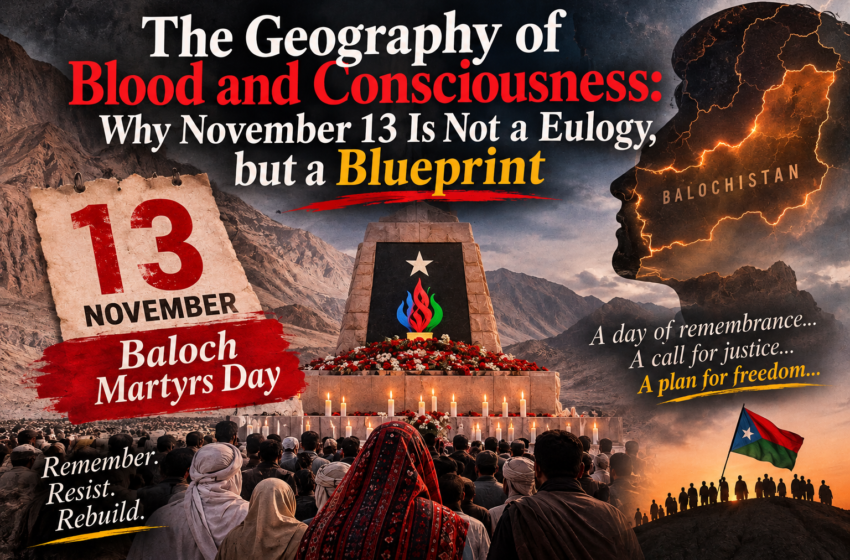
Why November 13 Is Not a Eulogy, but a Blueprint
By Rasal Jan Baloch
To remember is an act of defiance. For the Baloch nation, memory is not a passive museum; it is an active battleground. Every November 13, Baloch Martyrs’ Day demands more than tears. It calls for a rigorous and uncompromising evaluation of our collective conscience. We do not look back merely to mourn those who fell; we look back to realign our compass towards a sovereign, united, and completely free Balochistan, under the absolute ownership and rule of the Baloch people.
The significance of this date is rooted in a pivotal moment of national honour. On November 13, 1839, British colonial forces attacked the sovereign capital of Kalat. Vastly outnumbered, the 11th ruler of the Khanate of Kalat (Balochistan), Mir Mehrab Khan II, was urged by his advisers to surrender in the face of the empire’s superior military technology. His immortal response, “I may not defeat the enemy, but I can die for my motherland,” became the philosophical foundation of Baloch resistance. He and hundreds of his loyal warriors chose to die on their feet rather than live on their knees. Decades later, Baloch nationalist organisations and leaders formally designated November 13 as a collective Remembrance Day, establishing a timeless and borderless occasion to honour every son and daughter of the soil who has fallen resisting forceful occupation.
We honour Agha Abdul Karim, who raised the initial banner of modern defiance, and remember the enduring guerrilla legacy of Shaheed Mir Safar Khan Zarakzai, who chose the rugged dignity of the mountains over colonial assimilation. We bow before the intellectual pillars who gave our movement its vision and backbone. We walk in the shadow of Baba Khair Bakhsh Marri, who passed away naturally in his later years but whose mind remained an iron fortress, unyielding and unwilling to trade his nation’s soul for political compromises. We remember the thunderous defiance of Shaheed Nawab Akbar Bugti, who, even in old age, chose the harsh reality of a cave over the comforts of submission and perished beneath its rubble rather than bow to a tyrant. We also honour Shaheed Dr. Manan Baloch, whose grassroots organisational work challenged the foundations of the occupying power.
Our path has also been shaped by the strategic vision of leaders who believed that a small but dedicated group of committed individuals could awaken the consciousness of an entire nation. We remember Shaheed Balach Marri and General Aslam Baloch, who profoundly influenced the course of modern resistance and demonstrated the power of conviction in the face of overwhelming odds. We honour Shaheed Raza Jahangeer and the early student organiser Shaheed Hameed Baloch, who demonstrated the vital role of young people in the struggle for national freedom.
We also celebrate the towering cultural, scientific, and academic figures who used art, language, knowledge, and truth to strengthen national consciousness. We preserve the memory of Shaheed Dr. Qamber Qazi, a revolutionary poet and medical professional whose execution by state agencies only deepened collective resolve. We honour the dignity and sacrifice of Shaheed Agha Mahmood Khan Ahmedzai, who abandoned the comforts of the established system to defend national honour. We remember the unwavering revolutionary commitment of Shaheed Sangat Sana, who remained dedicated to his cause until his final breath. We draw inspiration from Shaheed Professor Saba Dashtyari and Shaheed Professor Ghamkhwar Hayat, who taught us that intellectual freedom carries a responsibility to challenge injustice. Above all, we bow our heads in remembrance of Banuk Karima Baloch, whose voice broke through international silence from exile and demonstrated that the flame of Baloch freedom burns just as fiercely in our daughters, sisters, and mothers.
The sacrifices of our people are not confined by artificial geographical boundaries. Tyranny has sought to divide the Baloch homeland by imposing borders that separate its eastern and western regions under the control of Pakistan and Iran. Yet the blood of our martyrs recognises no such colonial divisions. The aspiration for a united Balochistan remains a single and indivisible cause.
In Iranian Occupied Balochistan, the struggle against Iranian domination has produced its own remarkable figures. We remember Mir Dost Mohammad Khan Baranzai, the last independent ruler of western part of Balochistan, who refused to accept the loss of his territory and was executed by Iranian authorities in 1928. We honour the legendary guerrilla figure Dad Shah, who, during the 1950s, turned the rugged mountains into a formidable challenge for Iranian imperial forces, demonstrating the determination of the Baloch people to resist foreign rule. We also draw political inspiration from Jumma Khan Baloch, who initiated organised nationalist efforts in Damascus in 1964 with the aim of opposing Iranian domination and advancing the vision of a reunited and borderless homeland.
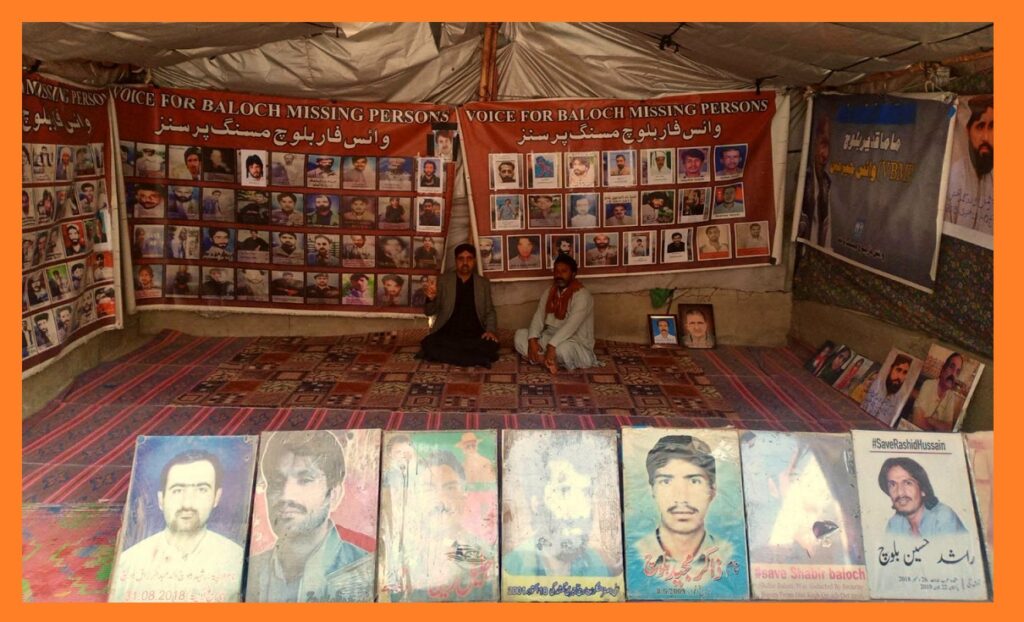
The reality of this borderless oppression was tragically demonstrated during the Zahedan Massacre, also known as Bloody Friday, when peaceful Baloch protesters and ordinary citizens were targeted by Iranian state security forces. We remember the fallen Baloch sons and daughters whose deaths became international symbols of collective suffering. Among them was Khodanoor Lajei, whose image of defiance resonated across the world. We also remember Mohammad Amin Gamshadzehi and Jaber Shiruzahi, whose young lives were violently taken, alongside Saman Rahmanpour, Zar Bibi Esmailzahi, and Mohammad Iqbal Naibzahi. Whether killed in the streets of Zahedan, lost in the torture cells of Quetta, fallen on the plains of Turbat, or executed on the gallows of Tehran, each represents a human life caught in the same struggle for dignity, justice, and freedom. Their sacrifices transcend provincial and geographical divisions. They remind us of the aspiration for a complete, sovereign, and self-governing Baloch nation, stretching from the Koh-e-Suleman to the shores of Gwadar and to the peaks of the Zagros mountains.
Oppression survives by convincing the occupied that their subjugation is permanent, natural, and unavoidable. The oppressor wants people to believe that resistance is futile, that their culture is inferior, and that their survival depends entirely on obedience.
The martyr and the lifelong dissident challenge this illusion. By choosing to endure death, torture, imprisonment, or exile rather than surrender their dignity, they demonstrate a fundamental truth: the power of an oppressor is finite, but the human desire for freedom cannot be extinguished.
Consider Baba Khair Bakhsh Marri, whose determination never diminished through decades of imprisonment and isolation. Remember Banuk Karima Baloch, whose spirit could not be silenced even in exile. Their lives and sacrifices demonstrated that the idea of Balochistan is greater than any individual life. Their legacy leaves an uncomfortable but necessary question for those of us who remain: If they gave their lives, their youth, and their blood to preserve Baloch identity, what are we doing with the lives and opportunities we still have?
Apathy dishonours the sacrifices of those who came before us. Cynicism only strengthens the forces that seek to suppress our identity. Grief that never develops into constructive political engagement, intellectual growth, and organised civic action risks becoming an endless cycle of suffering. We have mourned for generations. Now, that emotion must be transformed into political awareness, intellectual discipline, and unwavering solidarity.
One of the greatest advantages an occupying power can exploit is division within the occupied population. Tribalism, regionalism, ideological rigidity, and personal rivalries are luxuries that a struggling nation cannot afford. If those who sacrificed their lives shared an ultimate aspiration, how can we justify remaining divided in our everyday political and social lives?
The pursuit of a free and united Balochistan requires a transition from fragmented and isolated efforts towards a coordinated, nationwide political and social movement. This transformation must take place openly, institutionally, and collaboratively across every village, city, university, and diaspora community.
Individual organisations, political parties, and factions must recognise that their names, symbols, and personal ambitions have little meaning if the larger national cause is undermined. The interests of the nation must always take precedence over individual or organisational identities. The ultimate responsibility is to protect the national aspiration for which generations have sacrificed so much.
Unity, however, does not require absolute ideological conformity. It requires agreement on a shared minimum programme based on national survival, the protection of natural resources, political rights, and the right of the Baloch people to determine their own future. Different political perspectives can coexist within a broader national consensus, provided there is a commitment to mutual respect and common principles.
Genuine unity also requires open discussion, intellectual exchange, and institutional cooperation. We must establish inclusive spaces where intellectuals, workers, students, political representatives, and elders can exchange ideas, debate differences, and develop a common understanding of the challenges facing the nation. Disagreement should not become an excuse for hostility, and political differences should not prevent cooperation on shared national priorities.
The responsibility for this historical transition rests particularly heavily on the shoulders of Baloch youth. You are the emerging intellectual, digital, and political generation of Balochistan. You cannot afford to surrender your future to distraction, indifference, or despair.
The martyrs did not endure imprisonment, execution, exile, and decades of hardship so that the next generation could become silent spectators while its identity and collective rights were challenged. Their sacrifices have left a historical responsibility for those who follow them: to preserve national identity, strengthen political consciousness, and work towards a future based on dignity, justice, and self-determination.
First and foremost, young people must invest in knowledge and intellectual development. A political movement without a strong philosophical and intellectual foundation is vulnerable to manipulation and division. Read, analyse, write, and debate. Develop an understanding of international relations, global geopolitics, international law, economics, history, and human rights. A well-informed generation is better equipped to explain its aspirations, defend its rights, and engage with the international community.
Young people must also build relationships beyond familiar social and political circles. Tribal affiliations, dialectical differences, and regional identities should never become permanent barriers to national cooperation. Building mutual trust, encouraging dialogue, and establishing meaningful connections across different sections of society are essential to developing a stronger and more inclusive national consciousness.
Equally important is the responsibility to communicate the Baloch perspective to the wider world. International awareness does not emerge automatically; it requires consistent, credible, and responsible engagement. Through literature, art, digital media, human rights advocacy, journalism, and academic research, young Baloch voices must present their history, experiences, political aspirations, and demands for justice to an international audience. The struggle for recognition must be supported by facts, intellectual credibility, and a commitment to human dignity.
November 13 is a powerful reminder that the cause of freedom has already been paid for through the sacrifices of generations. Its price has been the blood of our finest minds, our bravest young people, our most brilliant poets, and our wisest elders, many of whom went to their graves with their convictions intact and their dignity unbroken.
We do not stand at an ordinary crossroads. The historical challenge before us is to pursue a future in which Balochistan is free, sovereign, and united, with the Baloch people exercising their right to determine their political destiny and govern their own affairs.
Let this day become a turning point where emotion is strengthened by reason and grief is transformed into constructive, organised political engagement. Let it be the moment when the scattered voices of a divided nation come together around a common demand for freedom, justice, and self-determination.
Honouring the martyrs is not simply about mourning their deaths; it is about preserving their memory, understanding the principles for which they stood, and carrying forward their aspirations through peaceful political engagement, intellectual commitment, national solidarity, and sustained civic action.
Let us remember. Let us reflect. Let us unite. And let us work towards a future in which the Baloch people can live with freedom, dignity, equality, and justice in their homeland.
About the Author: Rasal Jan Baloch is a pro-freedom Baloch political & Human Rights Activist.
Disclaimer: The views and opinions expressed in this article are solely those of the author and do not necessarily reflect the official policy or position of Baloch Warna News. The publication provides a platform for diverse perspectives.