Dhurandhar: A Baloch perspective
By: Hafeez Hassanabadi
Overall, Dhurandhar is a good film. Its temperament, cinematography, editing, sound mixing, visual effects, and pacing are all commendable. However, since there is talk of a sequel, it is important to highlight certain issues so that the mistakes made here are not repeated in the future and films on this subject can continue to improve. It is also hoped that, seeing the grand reception and box-office success of a film based on Baloch and Balochistan, many more films will be made on this topic.
1. Hamza Ali Mazari arrives in Karachi as an Indian agent and joins Rehman Baloch’s gang. Rehman and his entire team speak Balochi among themselves. While it is understandable that the film is in Urdu (Hindi), it should have been established, before Hamza joins the gang, or at some suitable point, how and when he learned Balochi. Even a brief 30-second or one-minute exchange would have sufficed.
This clarification was especially necessary because Mazari Baloch speak the Sulaimani dialect of Balochi, whereas Karachi’s Baloch predominantly speak Makrani or Rakhshani Balochi, heavily mixed with Urdu vocabulary.
2. If Ranveer Singh’s character had been named Rashid Ahmed, Zahoor Ahmed or any other Muslim name instead of Jagsrat Singh Rangi, a major technical issue would not have arisen. In a long, complex and dangerous undercover operation, unexpected situations, illness, injury, death, marriage, or romantic involvement are inevitable. In such circumstances, it would eventually become evident that he is not Muslim.
There were two simple solutions to this problem: First, instead of sending Jagsrat Singh from India, the story could have introduced a Muslim operative. Second, the issue could have been addressed through a brief conversation, such as: “It’s a good thing this operation (circumcision) wasn’t carried out there; otherwise, at the time of marriage, this detail could have ruined the entire plan.”
3. An especially glaring flaw is that he is shown marrying a medical student, yet she does not know that he is not Muslim. This is highly implausible.
4. In Baloch society, women are held in high respect. This is why figures such as Dr. Mahrang Baloch, Sami Deen, Dr. Sabiha Baloch, Beebo Baloch and Gulzadi Baloch play leading roles in the movement today. They enjoy full support from men, but this space has been earned through dignity, struggle and proven leadership.
Hamza Ali Mazari is portrayed as an attractive young man, and it is not surprising that a woman might be drawn to him or fall in love with him. Informing one’s parents about such feelings is not considered shameful in Baloch society. However, leaving one’s father’s home to live in a relationship is still far removed from Baloch cultural norms, especially for the daughter of a man who is not only Baloch but also a public figure living among his people. Such an act would not be accepted under any circumstances.
5. In the film, Shirani is shown as a BUF commander, yet his appearance closely resembles that of our Pashtun brothers; indeed, he looks strikingly similar to the well-known Pashtun religious leader of Balochistan, Maulana Muhammad Khan Shirani. With a broad-minded approach, this difference in attire might be overlooked to some extent.
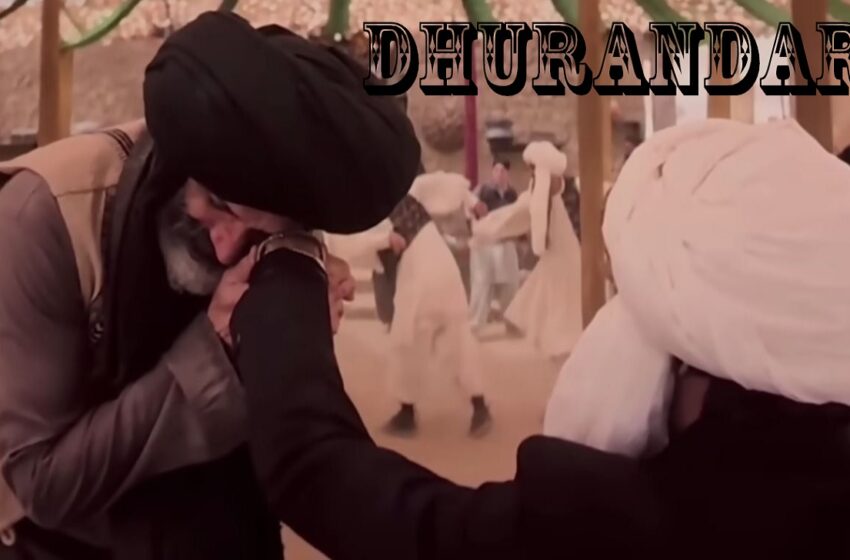
However, during his meeting with Rehman Baloch, portraying Rehman as superior, having Shirani kiss his hand and showing him handing over weapons is completely unjustifiable. Baloch sarmachars (freedom fighters), whom even Major Iqbal has acknowledged as fighting for their freedom, do not accept hereditary Baloch Nawabs or Sardars involved in Pakistani parliamentary politics. They view all of them, without distinction, as facilitators of the state. How, then, could they accept PPP’s Rehman Baloch?
This portrayal negates the core philosophy of the Baloch sarmachar’s characteristics and the Baloch nationalist forces. At the very least, such a misleading impression should not have emerged from an Indian film.
From several aspects of the film, it appears that the scriptwriter did not sufficiently research local political contradictions or the Baloch issue. Otherwise, Baloch sarmachars would not have been labelled “mujahedeen,” their commanders would not have been referred to as “Khalifa,” and Hamza Ali Mazari would not have introduced himself by saying, “My brother was a mujahid in Azad’s army.”
Everyone knows that “Azad” is used symbolically here, but in reality, Azad is a real figure in the Baloch liberation movement and one of the founding spokespersons of the Baloch Liberation Army. Those fighting for Baloch freedom do not call themselves mujahid; they call themselves sarmachar. The term mujahid is associated with Pakistan’s religious militants, often sent for money to fight in Afghanistan, Kashmir, Chechnya or the Middle East.
Sarmachar refers to one who sacrifices his/her life for the homeland. The Baloch fight solely for their land and national identity; they have nothing to do with religious supremacy or expansion. Tolerance toward all religions is, in fact, one of the finest qualities of the Baloch.
6. Portraying Pakistani terrorists killing innocent Indians with weapons allegedly supplied by the Baloch is the gravest injustice done to an already oppressed people. Pakistani forces kill Baloch while chanting “Allahu Akbar” and labelling them Fitna-e-Hind, while the Indian IB chief claims that the ISI acquires American and Russian weapons from other terrorist groups, and then the film establishes that these weapons came from the Baloch United Front.
Could Pakistan not obtain such weapons from its own so-called mujahedin, whom it has patronised since 1979 and who possess both American and Russian arms? Why are the oppressed Baloch being blamed for crimes they have never even imagined committing?
If the aim was to highlight the Baloch cause, this was not the way to do it. Pakistan already harbours hatred toward the Baloch; creating hostility in Indian hearts against them is incomprehensible. The Baloch lack sufficient resources for war and repeatedly appeal to friendly nations for assistance. Recently, Baloch guerrilla commander Dr. Allah Nazar even appealed to India for the rifles surrendered by Pakistani soldiers in 1971, an appeal largely symbolic, given how outdated such weapons are, but indicative of their desperate lack of resources.
Yet the film depicts Shirani selling weapons to a PPP-linked figure. This is not a minor error; it is outright hostility toward the Baloch nation, portraying an oppressed people as equal partners in the crimes of their oppressors.
7. Chaudhry Aslam was a real person. To make him appear powerful, it was unnecessary to malign the Baloch nation by portraying them collectively as smugglers, thieves, deceivers and drug addicts, traits that Chaudhry Aslam himself embodied.
The young men from Noshki whom Aslam kills are shown as having supplied him with fake goods. In cinema worldwide, such criminals are often punished; many Indian films show heroes confronting such figures. What extraordinary injustice, then, did Aslam commit here that would establish him as a true villain? Had those Baloch youths been innocent, Aslam’s brutality would have been far more impactful, rather than justifying his actions by portraying his victims as guilty.
Even more disturbing is his dialogue: “Trust a crocodile, but never trust a Baloch.” This is not fiction. It is a direct insult to the entire Baloch nation, a people known for their inherent trustworthiness.
Pakistan has historically exploited this very trait as a Baloch weakness. Agha Abdul Karim Khan was sworn upon the Qur’an and asked to come down from the mountains; trusting the promise of dialogue, he complied, only to be sentenced to ten years in prison. Nawab Nauroz Khan met a similar fate, promised negotiations in the name of the Qur’an, asked to lay down arms, and once he did, he and his companions were imprisoned, while seven of his close associates, including his son, were hanged.
Yet it is this state and its dominant nation (Pakistani Punjabis) that accuse the Baloch of being untrustworthy. Ironically, even a British judge once remarked in a Lahore court that Punjabis are the only people in the world who lie even at the time of death, while others speak the truth.
Millions of viewers worldwide are unaware of these historical realities and will perceive the Baloch exactly as they are portrayed in the film.
Although Dhurandhar is a fictional film and not an autobiography, it deals with a living nation and an ongoing liberation movement. Characters such as Rehman Baloch, Arshad Pappu, Uzair Baloch, and Chaudhry Aslam are real individuals. Therefore, the film cannot be dismissed as pure fiction.
It was essential to understand the cultural, social and political boundaries of the Baloch nation and the realities of its liberation movement so that the film would not inadvertently become part of Pakistan’s state propaganda.
This is the same movement the state is attempting to crush through genocide in Balochistan and by isolating Karachi, once the centre of Baloch political consciousness, from the struggle. This is why Lyari was deliberately turned into hell, handed over to drug mafias and drowned in blood and chaos so it could never again contribute to the Baloch liberation movement.
Karachi’s Baloch, who until the 1970s were prominent in business, politics and social life, were gradually pushed into the margins. Despite relentless pressure, they never abandoned their struggle for survival and dignity.
Rehman Baloch’s rise and his desire to be addressed as a sardar stem from these deprivations. He might have lived longer had the Baloch liberation movement not re-emerged in 2005, reignited by the martyrdom of leaders such as Nawab Akbar Khan Bugti and Balach Marri. Earlier, figures like Rehman Baloch shifted between parliamentary parties out of frustration. Now, however, the Baloch had a third option and many were naturally drawn to it.
Even if someone like Rehman Baloch genuinely sought benefits for his people, the state could not deliver them, because keeping the Baloch fragmented and economically dependent is a deep-state policy that no political party can overturn.
If an ordinary, non-political man becomes disillusioned, he will inevitably turn to those who have always argued that this state will give nothing to the Baloch, and they will be proven right. Should that happen, Karachi will become extremely difficult to govern. This fundamental issue, the state’s patronage of gangs in Karachi and the systematic marginalisation of the Baloch, is barely addressed in the film.
Final Words: It is encouraging that Bollywood has finally paid attention to the Baloch issue, and that this attention proved commercially successful. However, while originality has become scarce in countries where films and television series are produced in abundance, Balochistan offers countless powerful stories at every turn.
Make films and TV serials about love, friendship and enmity, loneliness, war, bravery, downfall and resurgence, silence and cries drowned in noise, but portray them accurately.
When undertaking such projects, it is essential to have at least one advisor who understands the history, culture, literature and social fabric of Baloch and Balochistan. Otherwise, if Dhurandhar can include Punjabi dialogue in a film about the Baloch but not a single line in Balochi and not a single woman, not even the bride, wears a Balochi dress at a wedding, then perhaps in the next film a girl’s father will be shown demanding dowry, which does not exist in Baloch society.
Among the Baloch, it is the groom’s family that bears wedding expenses for both sides, unlike in India, where the bride’s family provides dowry.
These details may seem minor, but such nuances matter deeply. Ignorance of a nation’s culture, civilisation, and collective values can undermine even a film made with a multi-million-dollar budget.
Disclaimer: The views and opinions expressed in this article are solely those of the author and do not necessarily reflect the official policy or position of Baloch Warna News. The publication provides a platform for diverse perspectives.