Baloch Independence, Jamaat-e-Islami and the 1971 Genocide in Bangladesh
By Sadiq Raisani, Advocate
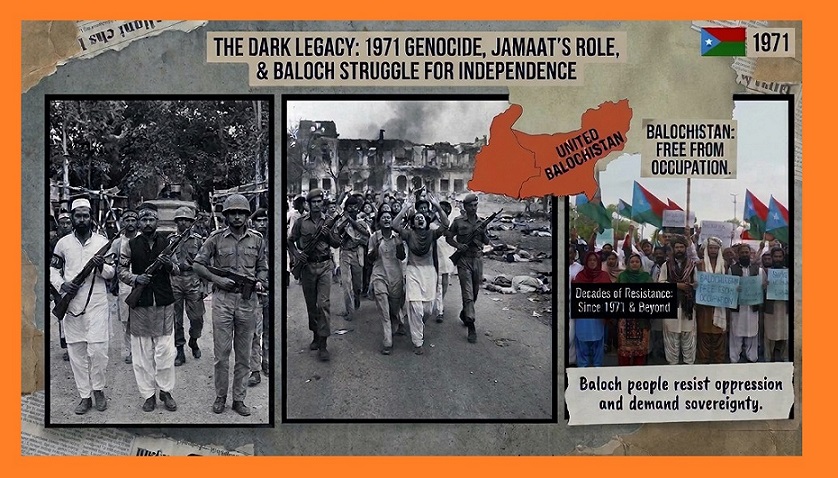
When examining the Baloch struggle for independence and the role of Jamaat-e-Islami, the history of Bangladesh provides an important historical example. In particular, the 1971 independence movement in East Pakistan, Jamaat-e-Islami’s political position, its cooperation with the Pakistani military, and the role of organisations such as Al-Badr and Al-Shams are historical realities that cannot be overlooked.
This subject, however, should not be understood merely in terms of religious differences or political opposition. It must be examined in the broader context of national liberation, political freedom, state power, ideological politics, and the right to self-rule.
The fundamental question is this: When the people of a region seek to determine their own political future, do religious and ideological parties stand alongside their national aspirations, or do they become instruments for defending state power?
Jamaat-e-Islami was founded on 26 August 1941 in Lahore by Maulana Abul A’la Maududi. Following the partition of India, the party remained politically active in both Pakistan and East Pakistan. It is also important to note that historically, occupied Balochistan was not part of India.
The 1970 general elections marked a decisive turning point in Pakistan’s history. Sheikh Mujibur Rahman’s Awami League won an overwhelming majority in East Pakistan and secured a majority in the National Assembly as a whole. Under democratic principles, the Awami League had the legitimate right to form the government. However, the transfer of power was obstructed.
On 25 March 1971, the Pakistani military launched Operation Searchlight in East Pakistan. Subsequently, the Bengali people’s political struggle transformed into a full-scale war of liberation, culminating in the establishment of Bangladesh on 16 December 1971.
Throughout this period, Jamaat-e-Islami in East Pakistan supported a united Pakistan and opposed Bangladesh’s independence. This is an established part of the party’s historical political record.
Three organisations played particularly significant roles during the events of 1971:
- Razakars: Local auxiliary forces that collaborated with the Pakistani military.
- Al-Badr: A force historically associated with activists affiliated with Islami Chhatra Sangha, the student wing of Jamaat-e-Islami.
- Al-Shams: Another local auxiliary force that supported the Pakistani military. Its members have been implicated in operations against Bengali supporters of independence through historical allegations and evidence.
On 15 July 2013, Bangladesh’s International Crimes Tribunal delivered its verdict against Professor Ghulam Azam, the former chief of Jamaat-e-Islami. The tribunal found him responsible for crimes relating to the 1971 atrocities, including conspiracy, incitement, and complicity, and sentenced him accordingly.
This history reminds us of an important reality: religious identity and political allegiance do not necessarily go hand in hand. A political party may conduct its politics in the name of religion, but its true political character must be judged by its decisions and actions.
When examining Jamaat-e-Islami’s role in Balochistan, an important distinction must be understood. In Bangladesh, Jamaat-e-Islami’s position and role during 1971 are documented through historical records and judicial proceedings.
By contrast, the central issues of the Baloch national movement concern national identity, political autonomy, control over natural resources, enforced disappearances, state power, and the right to independence.
Jamaat-e-Islami’s political ideology, however, is based on the concept of an Islamic state and a religious political system.
These two political visions are fundamentally different.
In his research paper Balochistan: The State Versus the Nation, published by the Carnegie Endowment, Frederic Grare argues that Baloch nationalism cannot simply be dismissed as a matter of tribal chieftainship. At its core are genuine questions of political representation, control over resources, and national self-determination. He also examines the tensions between religious politics and nationalism within the framework of state centralisation.
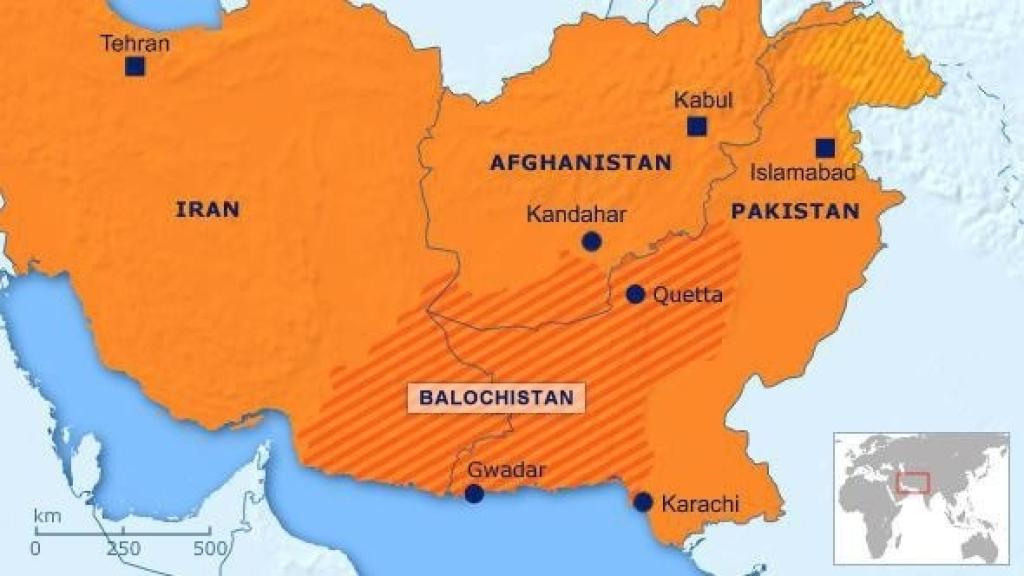
There is another interesting political dimension to this debate. Maulana Hidayat-ur-Rehman Baloch, a Jamaat-e-Islami leader in Balochistan, led the Haq Do Tehreek (Give Us Our Rights Movement) in Gwadar. The movement highlighted issues such as illegal trawling, the economic rights of fishermen, access to drinking water, education, healthcare, and other problems affecting the local population.
However, from a critical political perspective, the movement was seemingly part of a Jamaat-e-Islami strategy, developed in collaboration with the Pakistani military and elite, to counter the Baloch national movement. Its demands included genuine local grievances, which also gave the movement wider public appeal.
Nevertheless, an important political question remains: Does Jamaat-e-Islami’s support for the economic and civil rights of Gwadar’s residents extend to supporting Baloch national independence?
These are two fundamentally different political questions and should not be confused.
The history of Bangladesh offers several important lessons for the Baloch national movement.
When a nation’s fundamental concerns are national independence, political autonomy, and national identity, they cannot be resolved through slogans of religious unity or Islamic brotherhood alone.
In Bangladesh, the populations of both East and West Pakistan were predominantly Muslim. Yet their shared religious identity failed to protect the political, economic, and national rights of the people of East Pakistan.
Their political alliances, decisions, and practical conduct reveal their actual political character. Jamaat-e-Islami’s role in 1971 provides a significant historical example.
Today’s Jamaat-e-Islami in Pakistan and its predecessor in East Pakistan in 1971 should not automatically be treated as having different political positions simply because of the passage of time. In particular, the Pakistani Jamaat-e-Islami’s position on the Bangladesh genocide verdict remains aligned with the position of the Pakistani state, reflecting a continuing political disagreement over the historical events of 1971.
Its demands for national liberation, political priorities, and organisational decisions must remain under its own control. No religious party, state institution, or other political force should be allowed to impose its priorities on the Baloch national question.
Another important historical clarification is necessary: Jamaat-e-Islami and Jamiat Ulema-e-Islam (JUI) are two separate political parties. In 1972, Jamiat Ulema-e-Islam was an ally of the National Awami Party government in Balochistan; Jamaat-e-Islami was not. Confusing these two organisations would be historically inaccurate.
The history of Bangladesh demonstrates that a shared religious identity cannot substitute for a nation’s political rights, national identity, or aspiration for freedom.
The Baloch national movement must recognise that its political destination should be determined by the collective will of the Baloch people, not by the priorities of any religious party, state institution, or external political force.
The greatest lesson of history is that Jamaat-e-Islami supported a united Pakistan in 1971, while the Bengali nation’s struggle for independence continued on its own path and ultimately succeeded.
The Baloch people, too, must determine their political future through their own political consciousness, collective will, and national interests.
Disclaimer: The views and opinions expressed in this article are solely those of the author and do not necessarily reflect the official policy or position of BalochWarna News. The publication provides a platform for diverse perspectives.