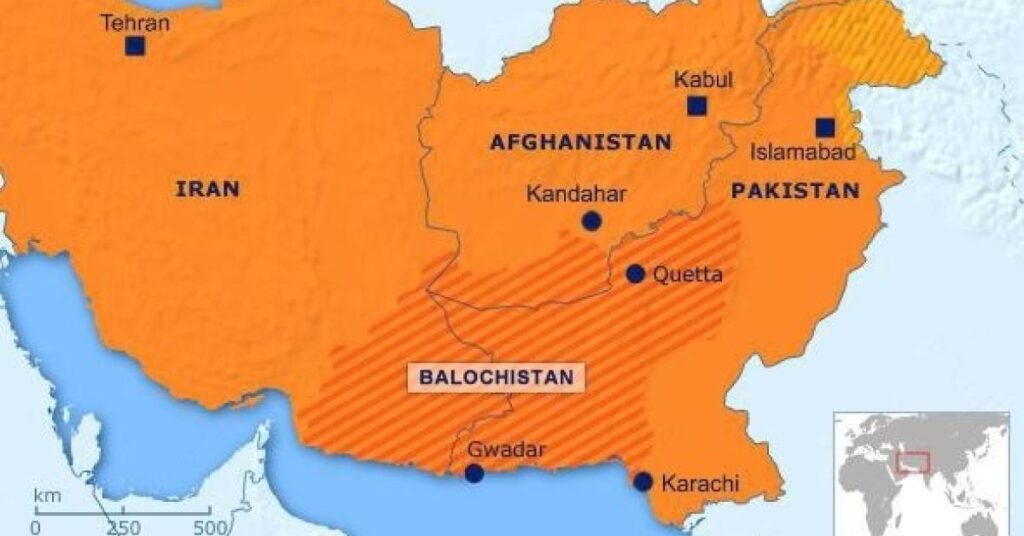

Timeline: The Baloch Resistance for Freedom of Balochistan
By Omar Baloch
Historically, colonial powers have maintained dominance and plundered natural resources from colonised populations by strategically creating internal divisions. A similar situation unfolded in Balochistan during the 19th century, when the region became administratively weak after the death of Noori Naseer Khan, the ruler of Balochistan at the end of the 18th century. This was the era of imperialism, when the British Empire had already taken control of the Indian subcontinent and extended its authority over Balochistan after murdering its ruler, Mir Mehrab Khan, on 13 November 1839.
There were several reasons behind British intervention in Balochistan, including the creation of a buffer zone to prevent Russian expansion towards warm waters and to safeguard British strategic interests. To consolidate their dominance, the British entered into a treaty with Kalat, taking control of Kalat’s foreign affairs while recognising its nominal sovereignty. They also implemented their notorious “Divide and Rule” policy.
Resistance of the Baloch in the Western Part of Balochistan
The Baloch tribal leadership resisted British encroachment on numerous occasions and defended the western regions of Balochistan against repeated invasion attempts by Persia (Iran). In order to strengthen control over the region, the British demarcated a boundary in 1871 known as the Goldsmid Line, dividing Balochistan into eastern and western parts without informing or obtaining consent from the Kalat State or Baloch tribal leaders. Control of the western part of Balochistan was transferred to Persia with British support, while the eastern region remained under British administration. This imposed division triggered a series of resistance movements in western Balochistan against both British interests and Persian occupation.
Mir Abdul Nabi, Sardar of Beyaban, frequently attacked the Indo-European Telegraph Line in protest against the division. This telegraph route along the Makran coast was vital for communication between London and Calcutta (Kolkata).
During the late nineteenth century, hundreds of Baloch tribal leaders mounted determined resistance against Persian occupation and British influence. In 1891, Persian authorities invited several Baloch guerrilla commanders for negotiations, swearing on the Holy Quran to guarantee their safety. Despite this solemn assurance, they were betrayed, arrested and later executed.
In 1896, the resistance led by Hussain Khan Naroi succeeded in asserting control over most of the western part of Balochistan. However, in 1898, he was arrested by Persian forces with assistance from the British, bringing an end to his administration.
In the early 20th century, leaders of the Barakzai (Baranzai) and other tribes regained control of significant areas in western Balochistan. The alliance formed by Syed Khan, Ameer Baranzai and other leaders played a critical role in this resurgence. Mir Bahram Khan Baranzai became a pivotal figure, offering refuge to Baloch leaders from the eastern region between 1907 and 1914 and establishing substantial influence across the territory. In response to persistent unrest, especially in eastern Balochistan, the British eventually dispatched a delegation to Mir Bahram Khan Baranzai, formally recognising him as ruler of western Balochistan while they maintained control over British Balochistan and Kalat.
During this era, the tribes of Yar Muhammadzai, Ismailzai and Gamshadzai also resisted Persian incursions while Sarhad was under British control.
11 November 1928: Persia Reoccupies Western Balochistan
Two principal factors contributed to Persia’s reoccupation of western Balochistan (Iranian Occupied Balochistan). The first was the complex territorial fragmentation of Balochistan—particularly after 1893, when its northern region was annexed to Afghanistan following the demarcation of the Durand Line. The second was British support for the Persian monarchy in maintaining control over the artificially imposed Goldsmid Line, which strengthened Persia’s position.
Under the rule of Reza Shah Pahlavi, Lieutenant General Amanullah Jahanbani, with British support, succeeded in arresting Mir Dost Muhammad Khan, nephew of Mir Bahram Khan Baranzai and ruler of western Balochistan. Hence, this part of Balochistan subsequently fell under Persian control once again. Mir Dost Muhammad was later deceived and executed.
Baloch Resistance Against Iranian Rule Remains Unbroken
Although Balochistan came under occupation, Iran struggled to establish sustained control in the region and faced numerous uprisings. Daad Shah led one of the most prominent resistances during the 1950s. His efforts gained international attention after Iran accused him of killing three Americans and successfully portrayed him as a terrorist. Both Iran and the United States announced a bounty for his capture or killing. Pakistan also agreed to assist Iran in this campaign. Daad Shah was eventually martyred during a gun battle with Iranian forces, reportedly after being betrayed by a tribal chief, Mir Mohim Khan. His life later became the subject of a film, and he remains an important figure in Baloch resistance history.
The Balochistan Liberation Front (BLF), founded in 1964 by Jumma Khan, revitalised the struggle for a united Balochistan. Courageous Baloch leaders—Abdul Samad Ameeri, Akbar Barakzai, Mir Abdi Khan, Moosa Khan Lashari, Rahim Zardkohi, among others—stood together in this uncompromising struggle for freedom. Although the movement originated in western Balochistan, by the mid-1970s the BLF found itself fighting not only Iran but also the Pakistani state in the eastern part of Balochistan (Pakistan Occupied Balochistan).
During this period, the BLF became a symbol of national aspiration. Syria, Iraq, Egypt, and the Palestine Liberation Organisation expressed solidarity. Syria recognised Jumma Khan in 1965 as head of a provisional government of Balochistan in exile and Egypt permitted Baloch offices to operate. Radio stations in Iraq and Afghanistan broadcast messages supporting Baloch freedom.
However, international support—particularly from Iraq—waned in the mid-1970s. The consequences were severe. Mir Abdi Khan and hundreds of followers were eventually forced to surrender. Shortly afterwards, Pakistani authorities raided the Iraqi Embassy in Islamabad and reportedly found crates of weapons allegedly destined for the BLF and other Baloch groups. This incident paved the way for yet another harsh Pakistani military aggression in Balochistan.
These successive events brought BLF activity in both eastern and western parts of Balochistan to the brink of collapse. Yet what endured was the unbroken spirit of the Baloch nation—a people who repeatedly rose in defence of dignity, identity and the aspiration for a free homeland.
Rahim Zardkohi’s struggle under the banner of Baloch Raaji Zrombesh is also noteworthy. The organisation was later renamed Balochistan Raaji Zrombesh (Balochistan National Movement) and is now mostly based in the United Kingdom, Europe and Scandinavian countries.
The Baloch People’s Democratic Party, which advocated the right to self-determination, was banned soon after its formation.
In 1982, the Iranian government intensified its crackdown on Baloch activism. Numerous activists were arrested, tortured and martyred, while thousands fled into exile—some to Afghanistan, others to the Middle East or Europe. Many sought refuge in Karachi and Quetta, carrying with them both trauma and hope.
The New Wave of Baloch Resistance for a United Balochistan
At the beginning of the 21st century, a renewed and more organised wave of resistance emerged in the eastern part of Balochistan, building upon earlier struggles for a united homeland. Its foundations were laid in the early 1990s by the legendary Nawab Khair Bakhsh Marri and his son, Sangat Hyrbyair Marri, after their return from Afghanistan.
Several leaders and organisations—including BSO Azad—joined the national movement for a united Balochistan. Martyred Ghulam Mohammad, chairman of the Baloch National Movement (BNM), and his comrades gained widespread popularity, especially in the Makran region. Martyred Professor Saba Dashtyari inspired the Baloch nation with his fearless speeches against the occupations of Iran and Pakistan. Gradually, the freedom movement spread across Balochistan and won the hearts of the people.
In response, Pakistan intensified its campaign of large-scale repression. Numerous prominent figures—including Nawab Akbar Bugti, Balach Marri, Ghulam Mohammad Baloch, Sher Mohammad Baloch, Lala Munir, Sangat Sana Baloch, Zakir Majeed Baloch, Tariq Kareem Baloch and many hundreds of others—were martyred. Despite the suffering, the movement endured. Unfortunately, one faction under new leadership later retreated, limiting itself to Pakistani-occupied Balochistan and even openly seeking support from Iran.
Sangat Hyrbyair Marri emerged as a powerful voice for a united Balochistan on the global stage, especially in Europe. Under his leadership, the Balochistan Liberation Charter became a landmark achievement. The first document produced by any Baloch leader which the future road map of free united Balochistan, not only for the international community, but it is also a contract with the Baloch nation that their equal rights will be guaranteed after the freedom of Balochistan. He and his comrades then founded the Free Balochistan Movement (FBM), creating a platform to unite Baloch activists across both sides of the Goldsmid Line and strengthen the struggle for national independence.
Two Occupiers, One Nation: The Baloch Fight for Survival and Freedom
Iran and Pakistan have both occupied Balochistan and are involved in systemic violence against the Baloch nation while exploiting its natural resources. Despite overwhelming repression by two powerful states, the Baloch people have consistently resisted. Both countries continue to suppress the Baloch nation through brutality, intimidation and fear, yet this has never silenced the Baloch voice for dignity, justice and freedom.
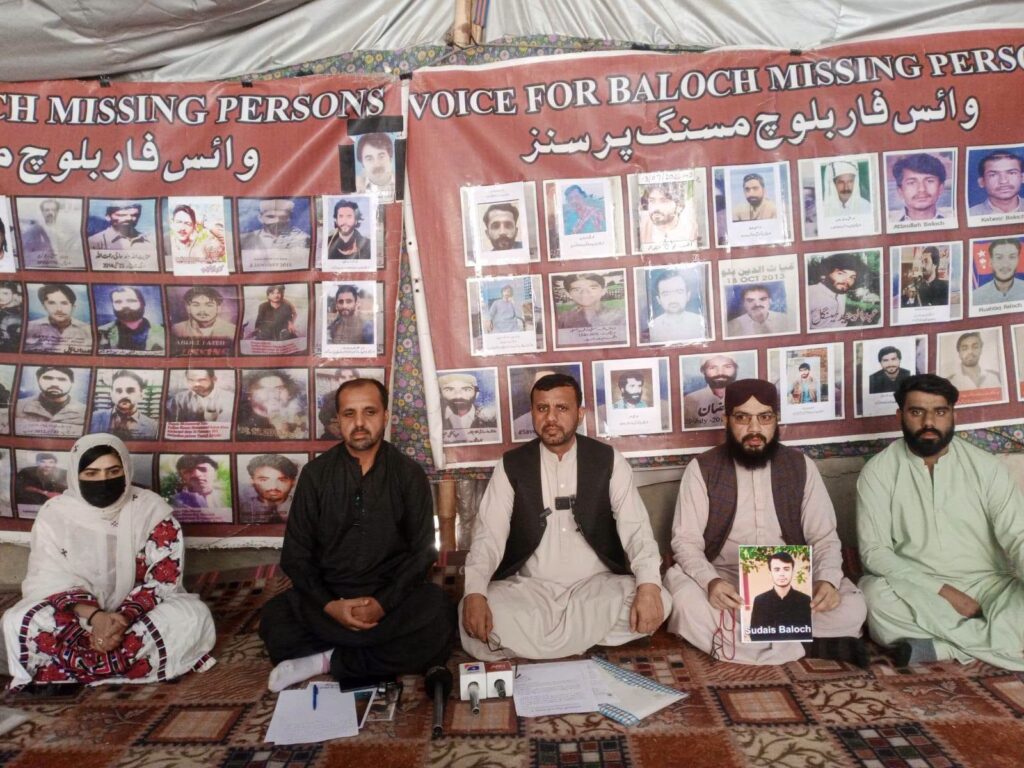
In Pakistan, enforced disappearances, extrajudicial killings, and staged encounters remain widespread. The discovery of mass graves in Tootak, Khuzdar, on 25 January 2014—where 169 mutilated bodies were reported—stands as one of the darkest examples of this state-sponsored violence.
Iran routinely executes Baloch individuals on fabricated charges. The Zahedan massacre, or “Bloody Friday,” on 30 September 2022—when Iranian forces opened fire on peaceful Baloch protesters, killing more than 120 people and injuring hundreds of others—remains a stark reminder of the deadly oppression faced by the Baloch people.
Both states have long cooperated in military operations against the Baloch nation. Iran supplied Pakistan with military equipment during the Chamalang Massacre in the mid-1970s, during which an estimated 8,000 Baloch—including women and children—were killed, injured or abducted.
In the recent Past, during Musharraf’s era, Pakistan handed over several Baloch to Iran and Iran arrested and handed over Younus Baloch to Pakistan. Both countries then executed the Baloch whom they had illegally handed over to each other.
The Shamsar Bombardment by Pakistan and Sabz Koh air strikes by Iran were yet another anti-Baloch collusion between both states. It appeared to the rest of the world that Iran and Pakistan were attacking each other, but in reality, it was a premeditated attack against Baloch; several innocent women and children, including, were killed on both sides of the artificial GoldSmid Line.
Most recently, Veteran Baloch leader Wahid Kambar Baloch was abducted, many claim he was arrested by Iranian forces, from Kerman, Iran, on 19 July 2024 and handed over to Pakistan. His fate and whereabouts remain unknown to this day.
Beyond military cooperation, both states routinely share intelligence and conduct joint operations to suppress the Baloch freedom movement, demonstrating their common hostility towards the Baloch struggle for survival and dignity.
If two occupiers can cooperate in exploiting and suppressing the Baloch nation, it is natural and necessary for the Baloch people to unite in resistance and reclaim their homeland.
As Dr Mahrang Baloch, leader of the Baloch Yakjehti Committee (BYC), has rightly stressed the unity of the Baloch on both sides of the Goldsmid Line, declaring that there is no Eastern or Western Balochistan— there is only one Balochistan.
Conclusion
The Baloch people have lived in their homeland, Balochistan, for thousands of years. Throughout history, the Baloch nation has resisted foreign invaders—the Mongols, the Portuguese, the Mughals, the British Empire—and today continues to resist Iran and Pakistan. Balochistan has been divided into three parts without the consent of the Baloch people, who now face ongoing oppression and attempted genocide. It is the duty of the Baloch nation to reclaim independence and unite all three parts into a free, democratic, and sovereign Balochistan.
Disclaimer: The views and opinions expressed in this article are solely those of the author and do not necessarily reflect the official policy or position of Baloch Warna News. The publication provides a platform for diverse perspectives.