Baloch Students Protest at QAU, Demand Action on Disappearance of Saeed Baloch
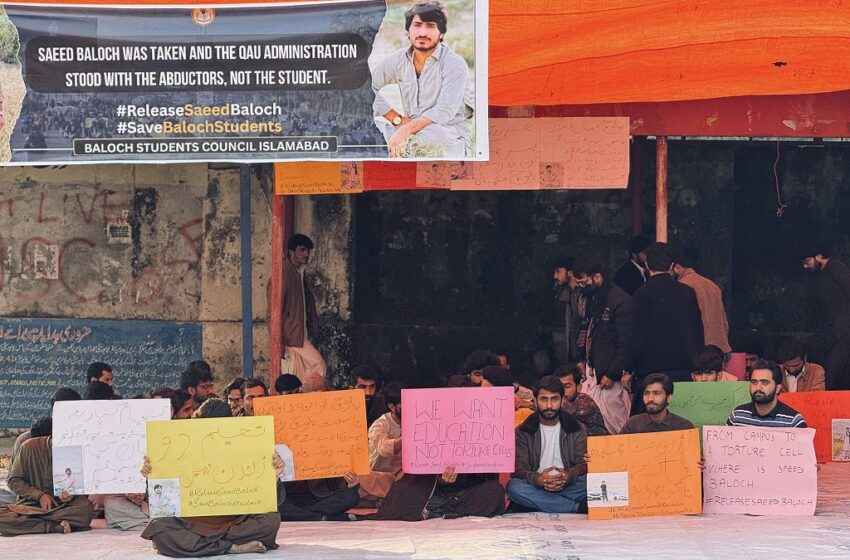
ISLAMABAD: The Baloch Students Council Islamabad (BSC Islamabad) QUA has escalated its protest at Quaid-i-Azam University, announcing that the campus will remain closed indefinitely until concrete steps are taken for the recovery of missing student Saeed Baloch. The announcement came during a detailed press conference held on Tuesday.
BSC Islamabad representatives stated that they had earlier staged a week-long sit-in from September 29 to October 5 inside the university premises. They ended the camp after receiving assurances from the QAU administration that legal assistance would be provided in Saeed’s case. However, the council said those assurances proved to be “false consolations,” forcing them to resume protest.
At the press conference, the council highlighted what it described as an alarming rise in harassment and profiling of Baloch students across Islamabad and Punjab. They accused state institutions of routinely intimidating Baloch students through late-night raids, questioning, and other forms of psychological pressure.
The BSC Islamabad cited several incidents as examples, including a 4 a.m. raid on Baloch students’ rooms at Arid Agriculture University Rawalpindi, sudden searches of student residences in Sargodha, the temporary disappearance of ten Baloch students from NUST and attempts to abduct students at gunpoint from Islamia University Bahawalpur. According to the council, such incidents have made it increasingly difficult for Baloch students to pursue their education without fear.
The council also criticized recent comments by Balochistan Chief Minister Sarfraz Bugti, saying his remarks appeared to justify profiling and surveillance of Baloch students. “If this is the stance of a provincial chief executive, then the safety of all Baloch students across Islamabad and Punjab is at risk,” the council said.
The BSC Islamabad further alleged that some QAU faculty members had issued threatening phone calls to Baloch students, warning them that speaking up about Saeed’s disappearance could affect their degrees. The council said this reflected a deeply troubling attitude within the university administration and hindered Baloch students’ academic progress.
Referring to Article 25-A of the Constitution, which guarantees the right to education, the students condemned the state’s failure to protect that right. They cited the 2022 disappearance of Feroz Baloch from Arid University and the July 2025 disappearance of Saeedullah Baloch from Islamabad Toll Plaza as evidence of a persistent pattern of targeting Baloch students.
BSCI’s Demands to QAU Administration
During the press conference, the council presented several demands, including:
- A transparent investigation into Saeed Baloch’s disappearance and immediate legal action against those allegedly involved, including a named DSS faculty member, Naveed Qaisar, who is directly involved in Saeed Baloch’s abduction.
- Direct dialogue between the administration and Baloch students, with regular updates on the case.
- Appointment of a responsible faculty representative to appear before the Islamabad High Court on December 1 to support progress in the case.
- Identification and legal accountability of individuals responsible for the disappearance.
- An end to threatening phone calls warning of academic retaliation.
- A written assurance from the administration guaranteeing active steps for Saeed’s recovery and safety for all Baloch students on campus.
The Baloch Students Council announced that Quaid-i-Azam University would remain closed indefinitely until the administration takes meaningful action on the disappearance of Saeed Baloch and fulfils the listed demands. “The responsibility for this shutdown lies with the university administration, the DSS department and the faculty members involved,” the council declared.
The escalation marks one of the most significant protest actions by Baloch students in the federal capital, highlighting growing tensions over security, discrimination and academic freedom.