Why the TTP Is a Deadly Threat to Baloch Secularism
By: M.B. Marri
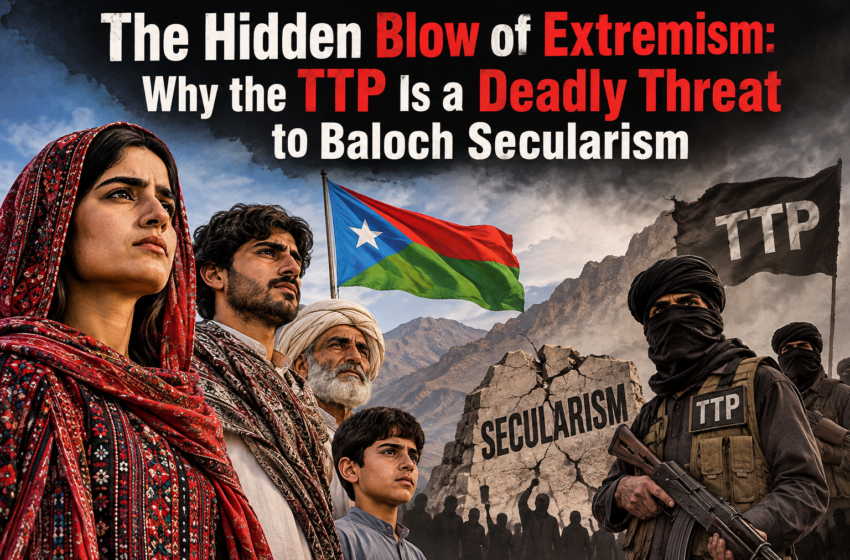
The growing presence of Tehreek-e-Taliban Pakistan (TTP) in Balochistan and recent reports of its establishment of new hideouts are a wake-up call for every member of our society. In a land already scarred by decades of conflict and enforced disappearances, the arrival of religious fanatics is not merely a shift in the regional security situation; it is a direct assault on the secular identity of the Baloch national struggle.
The roots of our struggle for Baloch identity and the right to self-determination have always been firmly embedded in secularism, cultural preservation, and progressive nationalism. Unlike other movements in the region that revolve around sectarianism or religious fanaticism, the Baloch struggle has never been a religious war. Tolerance is central to our traditions, where tribal values and national consciousness take precedence over religious extremism. Allowing a hard-line extremist organisation like the TTP to establish a foothold on Baloch soil would be tantamount to hollowing out our secular foundations from within.
To understand this contradiction, one only needs to consider the organisation’s very name: Tehreek-e-Taliban Pakistan. Its ideology, insurgency, and objectives are fundamentally tied to the Pakistani state and the imposition of its own self-proclaimed version of Sharia within Pakistan’s borders. Although the TTP may appear to be in confrontation with Islamabad today, its ideological roots lie in the same state-sponsored Islamisation and strategic-depth policies that Pakistan’s intelligence agencies cultivated for decades. The Pakistani establishment has consistently used religious proxies as weapons to suppress secular nationalist movements in Balochistan and the Pashtun regions, employing local death squads and sectarian groups to divide, discredit, and weaken genuine resistance.
To view the TTP as anything other than an extension of this state machinery—whether operating under a covert agenda or as ideological mercenaries—would be a dangerous mistake. When an armed group cultivated in the state’s laboratories enters a conflict, it effectively serves the state’s ultimate objective: transforming a political struggle for national liberation into a bloody religious proxy war that the international community will immediately reject.
Today, the Baloch nation faces a fundamental question: Even if so-called independence were achieved through an alliance or compromise with forces like the TTP, what would that independent Balochistan look like? It would certainly not be freedom. Replacing Rawalpindi’s military domination with the religious dictatorship of the Taliban would be nothing more than exchanging one set of chains for another. If the objective of the Baloch struggle is liberation from Pakistan, then tolerating, accepting, or supporting fighters whose entire existence revolves around Pakistan and who serve as ideological instruments of the very system we are fighting against is devoid of any moral or political logic.
History bears witness to the fact that whenever secular liberation movements have fallen for the deceptive notion that “the enemy of my enemy is my friend” and entered into temporary compromises with religious extremists, those extremists have ultimately swallowed the entire revolution. The Baloch people are fighting for a modern, democratic, and secular homeland where women, minorities, and political activists can live with dignity and respect. This vision stands in complete opposition to the ideology of the TTP.
Therefore, the message from all Baloch freedom fighters and Sarmachars must be unequivocal: The TTP must be expelled from Balochistan and driven back to Pakistan, where it belongs. They are Pakistanis fighting Pakistan’s war, and they have no place on Baloch soil. We will achieve our freedom through our own strength and local resources, without any role for the TTP. We neither need Islamic extremists nor mercenaries created by Rawalpindi on our land, and we will never accept them.
To protect the sanctity and integrity of the Baloch national movement, it is essential to reject the TTP and all other extremist organisations like it outright. Our struggle is for national survival and secular freedom, and there is no room in Balochistan for these hidden pawns of religious extremism.
Disclaimer: The views and opinions expressed in this article are solely those of the author and do not necessarily reflect the official policy or position of Baloch Warna News. The publication provides a platform for diverse perspectives.