
The Weight of November: Why Baloch Martyrs’ Day Endures
By Basham Baloch
From the fall of Kalat in 1839 to today’s struggles over rights and identity, November 13 connects remembrance with unresolved history.
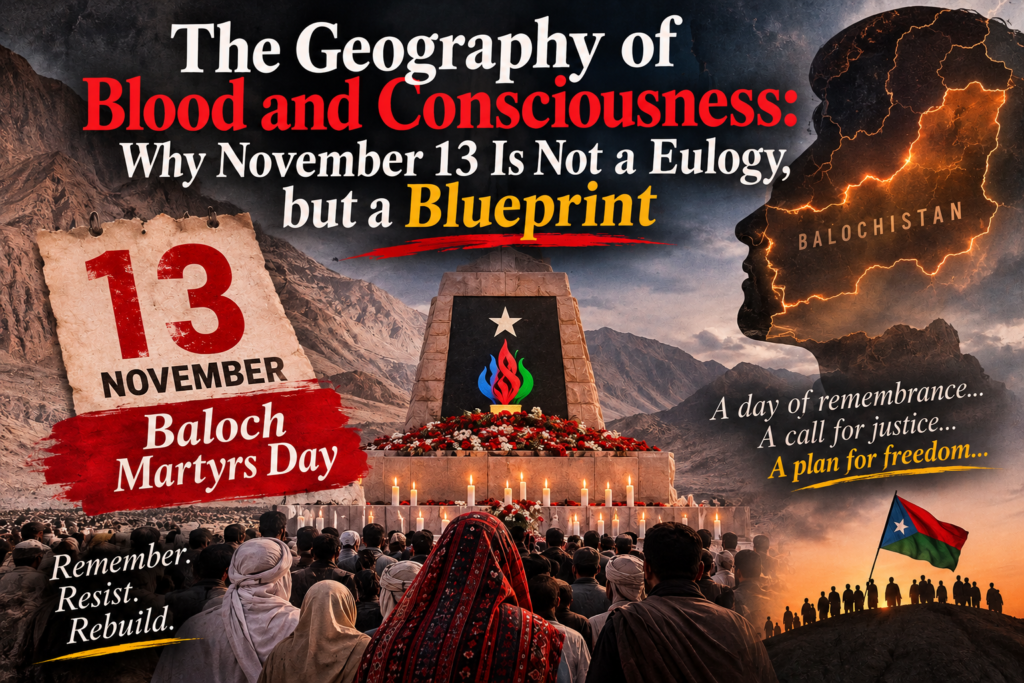
Some dates unite a people through remembrance and a shared aspiration for freedom. For Baloch patriots, November 13 is one such day: an occasion to honour their martyrs, stand together as a nation, and renew their aspiration for a liberated Balochistan.
Known as Youm-e-Shuhada-e-Balochistan, the day commemorates the lives lost across generations of political struggle and resistance. Its significance extends beyond mourning. It raises deeper questions about what a nation remembers, how collective memory survives, and why the past continues to shape the present.
The story begins with Kalat in 1839, but it does not end there.
For Baloch political and cultural movements, remembrance is a way of preserving history and keeping the sacrifices of previous generations alive. November 13 connects the defenders of nineteenth-century Kalat with later generations of activists, students, writers, and political leaders.
The day is observed in various ways, including seminars, candlelight vigils, poetry readings, and gatherings among Baloch communities at home and in the diaspora. These occasions bring questions of language, land, natural resources, and political rights into the same space as grief and remembrance.
For Baloch patriots, November 13 is a day to remember their martyrs and honour their sacrifices. It provides an opportunity to preserve their legacy, strengthen solidarity, and reaffirm the aspiration for freedom.
The date recalls the British assault on Kalat on November 13, 1839, during the First Anglo-Afghan War. British forces sought secure passage through Baloch territory towards Afghanistan. At Kalat, the confrontation culminated in an assault by troops under General Thomas Willshire. Mir Mehrab Khan, the ruler of Kalat, was killed while defending the citadel alongside his men.
In Baloch historical memory, Mehrab Khan’s death became a powerful symbol of resistance to imperial rule. The fall of Kalat remains central to narratives of sovereignty, colonial intervention, and the subsequent fragmentation of Baloch territories.
This is why the events of 1839 hold such significance for the observance. They provide November 13 with a historical foundation and a language of remembrance that later generations have adopted as their own.
Resistance to British expansion was not confined to Kalat. In the Koh-e-Suleman mountain range, Marri tribesmen fought British forces in conflicts commonly associated with the Anglo-Marri wars. In 1840, fighting around Kahan and the Naffusak Pass resulted in a serious setback for a British relief force. Another British expedition followed in 1880 after Marri attacks on military communications during the Second Anglo-Afghan War. Further hostilities led to a British military campaign against the Marri and Khetran tribes in 1918.
The memory of Kalat did not remain confined to the nineteenth century. Following the colonial-era conflicts, it became part of how subsequent generations understood the political struggles that emerged after the end of British rule.
Kalat declared independence in 1947 following the end of British rule. On March 27, 1948, Pakistan occupied Kalat, bringing its brief period of independence to an end. This event is remembered by the Baloch nation as an occupation rather than a voluntary accession. Later in 1948, Prince Abdul Karim launched an uprising that became one of the earliest expressions of resistance to Kalat’s incorporation into Pakistan.
Further waves of conflict followed during the 1950s and 1960s. The dismissal of Balochistan’s elected provincial government in 1973 was followed by a major insurgency and military operation that continued until 1977. These episodes brought further losses and deepened the region’s political grievances and collective memory.
In the contemporary period, the struggle has increasingly centred on political freedom, control over natural resources, and the protection of Baloch identity. According to Baloch historians, Hyrbyair Marri pledged loyalty to “my Nation” rather than Pakistan when taking his oath in 1997. The gesture can be viewed as a symbolic turning point in the modern Baloch liberation movement, reflecting an allegiance to Balochistan and its people.
Since the early 2000s, disputes over natural gas and mineral resources, and development projects such as Gwadar Port have contributed to renewed unrest and growing demands for national sovereignty.
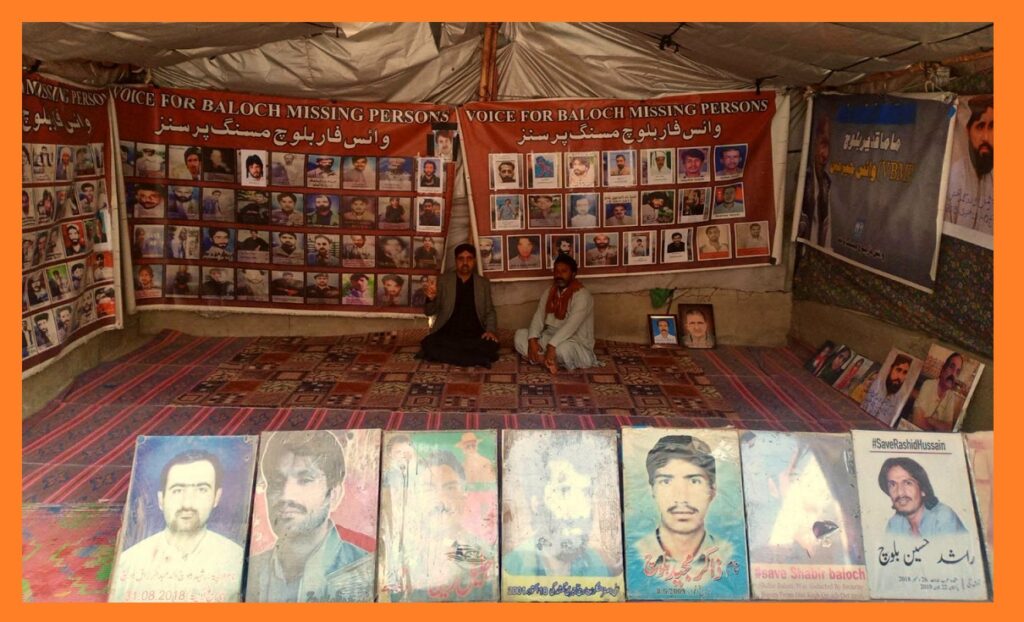
Human rights organisations, including Amnesty International and the Human Rights Commission of Pakistan, have reported enforced disappearances and extrajudicial killings by Pakistani forces in Balochistan. In response, Baloch armed groups have carried out attacks against Pakistani security personnel, infrastructure, and government installations, further escalating the ongoing cycle of violence and unrest.
The observance of November 13 extends beyond Mir Mehrab Khan and the defenders of Kalat. Baloch commemorations also honour figures from later periods, including Nauroz Khan, Nawab Akbar Bugti, Balach Marri, Ghulam Mohammad Baloch, Aslam Baloch, and Karima Baloch.
These individuals belonged to different generations and lived through distinct political circumstances. Remembering them together does not mean their experiences or struggles were identical. Rather, it demonstrates how a commemorative date can bring different lives, sacrifices, and historical experiences into a shared political and cultural memory.
For those who observe it, November 13 represents a day of unity for the Baloch nation. It is an opportunity to remember the martyrs, honour their sacrifices, and reaffirm a collective commitment to freedom. The day connects generations through the memory of those who lost their lives and the continuing aspiration for a liberated Balochistan.
Remembrance, however, carries a responsibility: to preserve the stories of those who came before, strengthen solidarity among communities, and continue the pursuit of liberation with dignity and purpose. In this spirit, Baloch Martyrs’ Day is not merely an occasion for mourning but also an opportunity to renew collective resolve.
The weight of November lies in this enduring promise: to remember the martyrs, stand together as a nation, and carry the aspiration for freedom into the future.
Disclaimer: The views and opinions expressed in this article are solely those of the author and do not necessarily reflect the official policy or position of Baloch Warna News. The publication provides a platform for diverse perspectives.