Blood in Afghanistan and Balochistan
By MB Marri Baloch
In a brutal escalation of cross-border violence, the Pakistani military once again unleashed its aerial bombardment late on the night of February 21, 2026. While the official narrative from Pakistan’s General Headquarters (GHQ) frames these actions as “intelligence-based, selective operations,” the reality on the ground tells a far more tragic story. In Afghanistan’s Nangarhar and Paktika provinces, these attacks have led to the cold-blooded massacre of innocent civilians, rather than the neutralisation of militants as claimed by the Pakistani authorities.
The true human cost of these so-called “selective operations” is staggering. According to verified reports from the Afghan border regions, at least 17 civilians, including 11 children, were killed in the midnight airstrikes. In Nangarhar’s Bihsud district, the attack on the home of 80-year-old Shahabuddin resulted in the complete annihilation of his extended family. A total of 23 family members, ranging from a one-year-old infant to elderly relatives, were buried under the rubble. These were not “tactical targets” but innocent civilians who perished as they slept. The targeting of residential areas and religious seminaries highlights the Pakistani military’s complete disregard for civilian lives in pursuit of regional dominance, where collateral damage is treated as little more than a footnote.
The timing of these airstrikes is no accident. The Pakistani military, which operates less as a national force and more as a mercenary entity, continues to sell its strategic location and soldiers’ lives to the highest bidder to maintain its hold on domestic power. In particular, Pakistan’s generals are eager to curry favour with the United States, offering a bloody display of force to prove their relevance in the global “War on Terror.” They aim to convince Washington that Pakistan remains an indispensable partner in the fight against extremism, despite their active role in fuelling the very instability it claims to combat.
Meanwhile, in Europe, the Pakistani military’s leaders participate in summits extolling the virtues of democracy and stability, all while back home, they oversee human rights catastrophes. Brussels and other European capitals must recognise that much of the financial aid and trade preferences they extend to Pakistan are diverted to sustain a military apparatus that ruthlessly suppresses its own people. For the military establishment, peace poses a threat to its financial interests, as prolonged conflict ensures a steady flow of international aid, advanced weaponry and geopolitical relevance. Every bomb dropped on an Afghan village is, in essence, an invoice sent to Washington and Europe, paid for in the blood of innocent civilians.
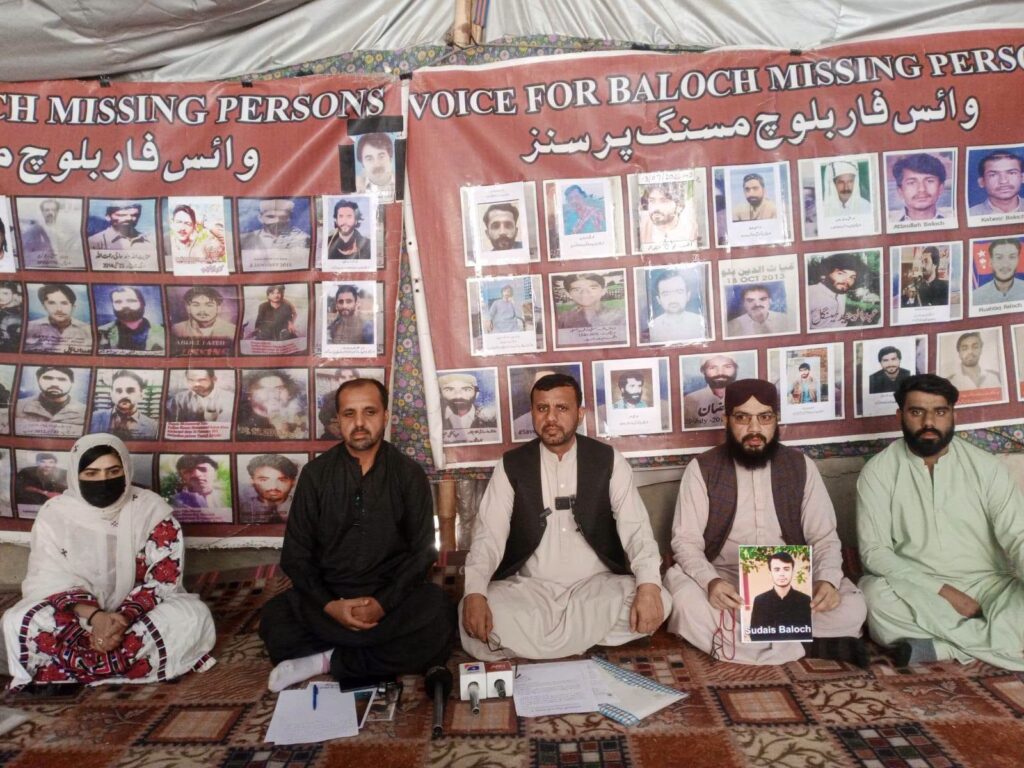
While the Pakistani military’s jets strike Afghan soil, its boots remain firmly planted on the necks of the Baloch people. Balochistan has become a testing ground for the Pakistani military’s most brutal tactics, including enforced disappearances, the “kill and dump” policy, and the collective punishment of entire families. The beginning of 2026 has seen an alarming escalation in the suffering of the Baloch. This week alone, security forces in the Gazgi area of Khuzdar forcibly disappeared 11 members of a single family, as the state increasingly targets the relatives of activists to silence the Baloch population through terror.
Balochistan’s natural resources, especially the Reko Diq gold and copper reserves, have long been plundered by the military. As Pakistan continues its occupation of Baloch lands, the local population remains among the poorest in the region, with the wealth of their lands filling the coffers of military elites. Human rights defenders and legal professionals who challenge this state oppression face heavy sentences or arbitrary detention. The Pakistani state treats even the most basic calls for civil rights as “fitna” (strife), justifying the complete suppression of civil liberties.
For the Baloch people, the struggle has always been far beyond a fight for civil rights. It is a desperate battle for survival against a state that views its very existence as a security threat rather than a legitimate humanitarian concern. The Baloch nation refuses to be divided by the colonial legacies of the past and its demands are clear: independence from both Pakistan and Iran.
In Pakistan-occupied Balochistan, the Baloch reject the illegal occupation and seek a sovereign state where their resources belong to the people, not the military generals. In Iranian-occupied Balochistan, they face the same repression, including mass executions and religious tyranny. The goal of the current Baloch national movement for freedom is a united and independent Balochistan, free from the mercenary greed of Islamabad and the oppressive rule of Tehran.
The international community can no longer afford to turn a blind eye to the state terror unleashed against the Baloch nation. Every time the Pakistani Army strikes Afghan villages or forcibly disappears Baloch families, it is violating the most fundamental principles of international law. The Baloch Diaspora and leader in exile have been calling upon the United Nations, the United States and the European Union to take concrete action against such violations.
Final Words: First, an Independent Commission of Inquiry should be established to document civilian casualties in the February 2026 airstrikes in Afghanistan. The Baloch people’s right to independence must be acknowledged, as the systematic oppression in both Pakistan and Iran is undeniable. The architects of the “kill and dump” policy by Pakistan and mass executions by Iran should face targeted sanctions. Washington and Europe must halt military aid to states that use international funds to destabilise the region and suppress nations seeking justice and freedom.
The blood of children in Paktika and the tears of families in Khuzdar are a testament to a military that has sold its soul for greed. It is time for the world to stop financing this mercenary machine and to start standing with the victims who have long been silenced but never give up their struggle for justice, freedom and human dignity.
Disclaimer: The views and opinions expressed in this article are solely those of the author and do not necessarily reflect the official policy or position of Baloch Warna News. The publication provides a platform for diverse perspectives.