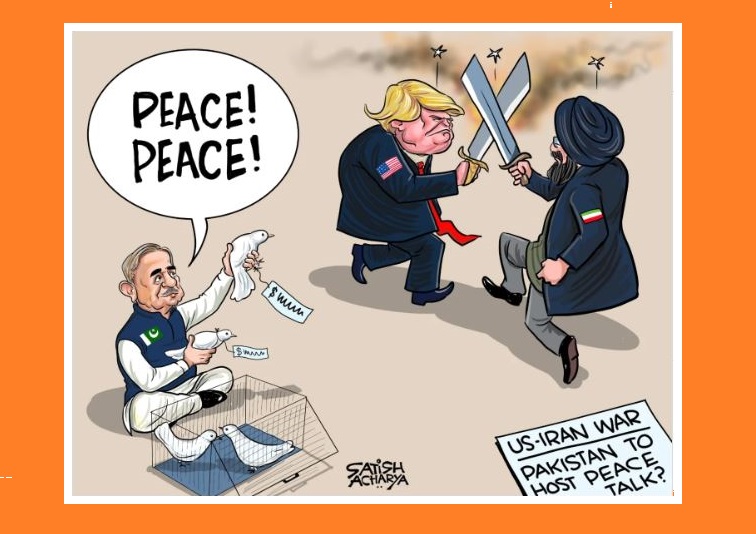
Cartoon by: Satish Acharya | Courtesy: Instagram
Iran–America Conflict: The Beginning of a New Long War
(Pakistan’s objective in mediating between America and Iran was not to achieve successful negotiations or a permanent ceasefire agreement, but rather to buy time for Iran under the cover of dialogue so that Iran, together with its allies, could better prepare to drive America out of the region and ….)
By Hafeez Hassanabadi
In our previous article, “There is only one option for Iran’s collapse,” we stated that the American-Israeli attack on Iran came at least twenty years too late. This is why not only are the chances of achieving significant results limited, but its negative consequences could also prove disastrous for several countries in the region, especially for the member states of the Gulf Cooperation Council (GCC).
As the German philosopher Nietzsche said, if an illness passes without taking our life, it means it has left us even stronger than before. The conflict initiated against Iran shows that the leaders of America moved forward while ignoring the views and advice of insightful people — both within their own circles and around the world — who, from the very beginning, had consistently argued, with solid reasoning, that external blows alone could not seriously damage Iran unless the country was first weakened from within.
What has happened now is evident to everyone: no regime change has taken place in Iran. Iran is not willing to hand over its enriched uranium to anyone — at least not to America under any circumstances — nor is it prepared to relinquish control of the Strait of Hormuz and the leverage it provides to blackmail the world. On top of that, Iran is not only demanding the release of its frozen assets and the gradual easing and eventual removal of all sanctions imposed on it, but it is also hopeful that these frozen assets will indeed be released.
Moreover, observing the temporary ceasefire, the drama of negotiations through Pakistan, and the unserious attitude surrounding the matter, it appears that America’s rulers are either taking this issue very superficially or they fail to comprehend the possible consequences of this war. Their statements make it seem as though they have completely crippled Iran, whereas the reality is quite the opposite. As long as the same regime remains in place, possesses sixty per cent enriched uranium and holds the key to the Strait of Hormuz, it can rebuild collapsed walls and destroyed bridges. The killing of certain leaders has not caused any political earthquake and replacements were selected smoothly without any major crisis.
Reasons for Failure:
For a change or revolution to occur in any country, several essential factors are required. These include public anger against the government, a clear roadmap or ideology, strong leadership, an organised party or the active role of a powerful alliance, the country’s economic condition, external factors, its relations with the outside world and their interests, coordination between domestic forces seeking change and foreign powers, a passionate determination to bring about change at any cost, and the role of neighbouring countries.
If one examines the situation carefully, only public unrest currently exists in Iran. All the other factors are either immature or entirely absent because no serious effort has been made to strengthen them. Therefore, in one way or another, nearly all these conditions are working in Iran’s favour.
The country’s economy may indeed be weak, but due to years of sanctions, it has already found ways to sustain itself. As far as external factors are concerned, in response to the delayed attacks by America and Israel, two veto powers — Russia and China — are standing firmly alongside Iran at the right time. Their deep economic, political and strategic interests have become so closely tied to Iran that they will not abandon it under any circumstances.
This is why Russia, through the Caspian Sea route, China through cargo trains and Pakistan through the Transit of Goods Bill, have opened land routes for Iran and decided to continue providing it with full support. Meanwhile, America not only seems incapable of confronting Russia and China, but now even appears completely helpless in front of Pakistan, as it is unable to stop Pakistan from taking such actions.
Observe America’s misfortune at the hands of fate: Once again, it has become trapped in Pakistan’s web and it still seems unable to understand that, even more than Iran, Pakistan desires America’s defeat and withdrawal from this region. According to Pakistani authorities, if America leaves this region this time, it will never dare to return again. Instead, it would have to conduct all its affairs in the region through Pakistan, thereby allowing Pakistan to emerge as the strongest power in the region by moving beyond its previous role as America’s watchdog.
It is regrettable to say that American officials seem to have forgotten that, from the war against the Soviet Union up to the establishment of a pro-American government in Kabul, Pakistan heavily used America for its own interests. It is on record that Pakistani General Hamid Gul once said that, in pursuit of Pakistan’s interests, they used American assistance to drive the Soviet Union out of Afghanistan, and that they would now use America’s own power and resources to force America itself out of Afghanistan. And that is exactly what happened.
Pakistan, which was supposedly America’s ally in the war against terrorism, was later found sheltering Osama bin Laden, the very man it was receiving American funds to help eliminate along with his organisation. In the past, including American President Trump and several prominent congressmen, many U.S. officials repeatedly stated that Pakistan was taking funds from America while simultaneously getting American soldiers killed; that it was not America’s ally, but rather an ally of terrorists.
Yet suddenly, without much thought, America accepted Pakistan’s mediation efforts and, as before, once again failed to analyse the deep ties and shared regional interests between Pakistan and Iran. They even failed to consider whether Pakistan, under the guise of negotiations, might actually be buying time for Iran while simultaneously weakening America’s position.
Pakistan, which for twenty years did not step forward to mediate between the pro-American government in Kabul and its “guest” Taliban until America itself had decided to withdraw, now suddenly developed a “goodwill spirit” to mediate between America and Iran. This is a very important question that Americans seem unable to understand.
In reality, Pakistan’s mediation is not intended to bring peace between the parties, but rather to first give Iran an opportunity to recover. In the short term, Pakistan benefits financially from this role, receiving dollars and aid through various channels from America. In the long term, however, Pakistan seeks to remain deeply involved in the dispute so that it can internally sabotage any effort that might bring about the kind of change in Iran desired by America.
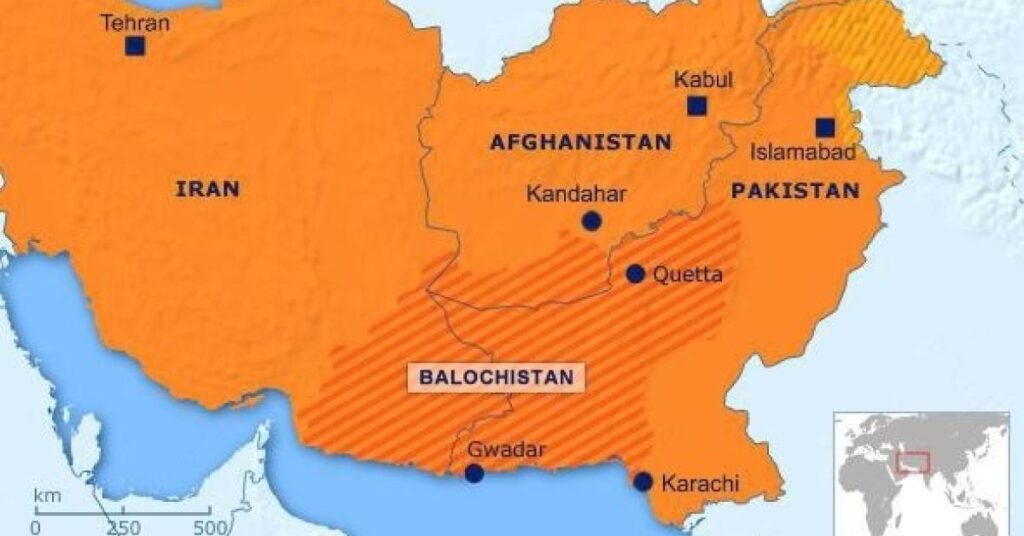
The reason is that if such a change were to occur and a pro-American government emerged in Iran, Pakistan’s own strategic importance in the region would diminish. Secondly, there is concern that the Baloch independence movement in Pakistan-Occupied Balochistan could gain momentum and possibly receive support from a new Iranian government, or even that Iranian-Occupied Balochistan could free itself from Iran. Thirdly, and perhaps most importantly, Pakistan seeks to use this crisis to create divisions among the Gulf states and entangle them in mutual conflict so deeply that, after America’s departure, they would become dependent on Pakistan’s assistance.
Why Are Iran and Pakistan Opposed to the UAE?
According to this viewpoint, Iran and Pakistan deliberately targeted the UAE as part of a broader strategy. Since the beginning of the war, Iran has launched its heaviest attacks against the UAE. According to Emirati official sources, Iran carried out 551 ballistic missile attacks, 29 cruise missile attacks, and 2,263 drone strikes against the country — reportedly three times more than the attacks carried out against Israel.
Meanwhile, Kuwait — where the largest number of American troops are stationed —faced around 600 missile and drone attacks. Qatar, which hosts CENTCOM headquarters and the massive Al Udeid Air Base, faced around 100 missile attacks and nearly 200 drone strikes. Bahrain and Saudi Arabia were also subjected to roughly 500 to 600 missile and drone attacks each.
The question arises: what did the Arab Emirates do that it has been targeted even more than Israel? In Pakistani media and on social media, Pakistani bloggers, vloggers, YouTubers, self-proclaimed intellectuals and influencers are aggressively portraying the UAE as the most oppressive country in the world.
So far, hundreds of programs and discussions have been held on this topic, claiming that because Dubai Port was closed, 11,000 containers were cleared within forty days through Pakistan’s Karachi Port, Port Qasim and Gwadar Port, which is said to be four times more than the entire previous year.
They express their happiness openly while also saying that if Dubai used to earn around two billion dollars per month from shipping, then Pakistan could earn five to six billion dollars per month through Karachi Port, Port Qasim and Gwadar Port.
This is the key point that is rarely stated openly, yet it is the fundamental objective behind why Iran and Pakistan, under the cover of the America–Israel–Iran conflict, are seeking to economically weaken and destroy Dubai.
At present, both Pakistan and Iran are trying to keep Dubai as disturbed and unstable as possible due to security concerns. Iran is currently hopeful that most of the sanctions imposed on it will eventually be lifted and in the event that Dubai remains shut down or unstable, the importance of Chabahar Port would increase significantly. Pakistan, meanwhile, sees insecurity in Dubai as a stroke of good fortune for itself.
Pakistan is working toward a situation in which, instead of a permanent ceasefire between Iran and America backed by global guarantors and clear signed agreements, there would be a Korean-style armistice — a tense and unresolved situation where both sides constantly remain in fear that war could break out again at any moment. If they succeed in creating such a scenario, the Gulf Cooperation Council (GCC) countries could be severely affected.
Pakistanis believe that if such circumstances emerge, they could surpass Dubai within the next five or six years. In Pakistani media, accusations are also frequently made that the UAE deliberately fuelled unrest in Karachi in order to weaken Karachi Port and thereby pave the way for Dubai’s rise and prosperity.
By making such claims, they are in fact expressing their own intentions: that if the UAE supposedly damaged Karachi in the past to help Dubai grow, then why should Pakistan not support every effort today that could shut down Dubai and open opportunities for Pakistani ports?
However, in saying this, they overlook the fact that Dubai achieved its global status through international trust, outstanding performance across sectors, massive investment and decades of hard work — qualities that are largely absent in both Iran and Pakistan.
Final Words:
At present, the situation is extremely grave and it may worsen further in the coming years because the global balance of power has already shifted. Due to the mistakes and miscalculations of its leaders, America is no longer the sole superpower, while China and Russia have emerged together in a position strong enough to stand against it.
A new world order is taking shape. The foundations of the U.S. dollar — the main source of American power — have begun to weaken and cracks have also appeared in the petrodollar system. In the global banking system, China has introduced its own CIPS network as an alternative to SWIFT and it is considered faster and easier in many respects. In the future, a BRICS currency could also emerge at any time to challenge the supremacy of the U.S. dollar.
During this conflict, both the Organisation of Islamic Cooperation (OIC), representing fifty-seven Islamic countries and the Gulf Cooperation Council (GCC) remained confused and largely inactive. Although they possessed the capability to do much more, they merely watched one another with concern and uncertainty.
In such circumstances, Arab countries will need to completely reconsider and redesign their strategies and policies because Iran and Pakistan are closely watching them with ambitious but ill intentions. These countries [Iran and Pakistan] will first attempt to create misunderstandings among Arab states and entangle them in secondary disputes and then gradually weaken them one by one until they become dependent and powerless.
In this situation, GCC countries — especially the UAE — will need to reassess and strengthen their relations with regional allies who have themselves become frustrated with the oppression and intrigues of Iran and Pakistan. Likewise, on the international level as well, it has become essential to reassess relationships and restructure them along new lines.
At first glance, this latter statement may seem very simple, but in reality, it is an extremely difficult and complex process. To achieve this, the GCC countries need comprehensive, powerful, and highly proactive think tanks composed of visionary individuals. If possible, each country should establish its own independent think tank. Alternatively, they should take measures to strengthen the capacity and effectiveness of the think tanks that already exist.
There is no doubt that the leadership of these countries formulated excellent policies for the development of their nations, due to which they achieved such remarkable progress that their development and the rule of law have become examples for the world. However, after this war, circumstances are likely to change significantly, and Arab leaders will need deeper analysis, sincere advice, constructive consultations, and meaningful debates more than ever before in order to move in the right direction. Only through wisdom and careful strategy will they be able to overcome the obstacles that may arise in the future with relative ease.
Disclaimer: The views and opinions expressed in this article are solely those of the author and do not necessarily reflect the official policy or position of Baloch Warna News. The publication provides a platform for diverse perspectives.