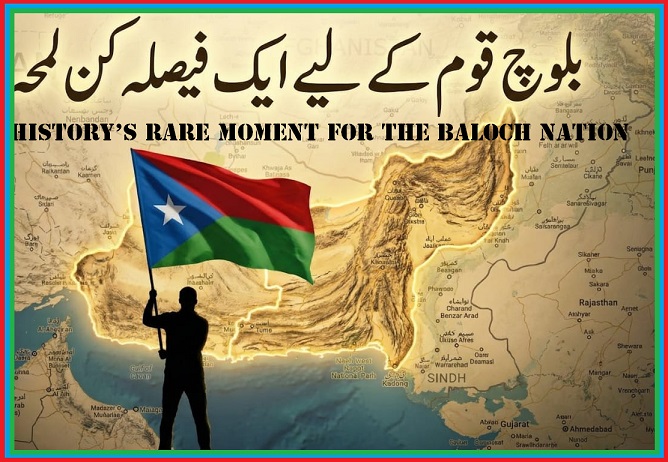
History’s Rare Moment for the Baloch Nation
By Shoresh Baluch
History sometimes presents nations with rare opportunities that test their insight and resolve. The Baloch nation has faced such moments multiple times in the past—moments where the course of history could have been altered. Unfortunately, many of these opportunities were lost due to internal divisions, organisational weaknesses and lack of international support. Today, as the geopolitics of the region undergo another period of profound change, an important question arises: will the Baloch nation recognise this moment, support the struggle for freedom, and move forward with foresight?
The roots of the Baloch issue go back to the 19th century. In 1839, when the British Empire invaded Balochistan, the region existed as an independent and autonomous state. This invasion was part of Britain’s broader imperial strategy in South and Central Asia. However, strong resistance from the Baloch leadership and people made it difficult for Britain to establish complete control.
As a result of this resistance, a treaty was signed in 1876 between the British Empire and Balochistan. Under this agreement, Britain formally recognised Balochistan’s independence and autonomy and established a system of strategic cooperation. Both parties were obliged to protect each other’s interests within their territories. Balochistan agreed not to establish foreign relations with any state hostile to Britain, while Britain was allowed to station a limited military force in Balochistan to counter external threats.
Yet history shows that the politics of power often undermines agreements. Over time, Britain weakened Balochistan’s governmental structure through political interference and various strategies. This created a complex situation: in principle, Balochistan remained a sovereign state (de jure), but in practice, imperial influence over its internal governance and foreign policy grew (de facto).
One severe consequence of this imperial strategy was the division of Balochistan’s territory. In the early decades of the 19th century, at Tehran’s request, Britain drew a boundary known as the Goldsmid Line, separating western Balochistan, Iranian Occupied Balochistan, from the rest of Baloch lands. This border was established without the consent of the Baloch people or their leadership, splitting a historically unified nation and region.
Despite this division, the Baloch of Iranian-occupied Balochistan resisted foreign rule. For decades, the Persian state struggled to establish control over the region. However, in 1928, Tehran, leveraging air superiority, conducted a military operation to seize control.
Since then, the Baloch people have continued their struggle in various forms—whether through armed resistance or peaceful political movements. In both Iranian- and Pakistani-Occupied Balochistan, Baloch movements have consistently demanded freedom. Yet due to power imbalances and limited global attention, the Baloch issue has often failed to receive the international recognition it deserves.
History also reminds us that opportunities have arisen before. The first significant moment came when Agha Abdul Karim Khan attempted to continue the struggle against Pakistan’s occupation of Balochistan. However, organisational weaknesses and lack of external support prevented this movement from being sustained.
The second opportunity arose in 1971, when Bangladesh achieved its independence from Pakistan, altering the political map of South Asia. Many observers believed this shift could strengthen the legal and political arguments for Baloch independence. Yet at the time, the Baloch movement was geographically limited and lacked broad popular support.
The third opportunity emerged during the Iranian Revolution of 1979, when Tehran’s political system underwent a complete transformation. The uncertainty and upheaval of that period could have reshaped regional politics. Yet, due to the lack of consolidated Baloch political power, this moment was also not effectively seized.
The present moment may be the most suitable, timely, and golden opportunity. Israel, the United States, the European Union and the Arab world are standing united against the Iranian state’s regional and global bullying. In such circumstances, the opportunity seems to knock at the door of the Baloch nation: if the Baloch unite under the banner of freedom on both sides of the artificial Goldsmid Line, they could leverage this moment to their advantage.
Yet history teaches a fundamental lesson: opportunities alone do not change a nation’s destiny. Real change comes when nations advance with unity, political insight and a clear democratic vision.
If the Baloch issue is to gain serious international attention, the Baloch nation must present itself united, with a clear commitment to democracy and the rule of law. The world pays attention to movements that not only raise historical grievances but also present a credible framework for a stable, democratic and peaceful future.
Today, the central question for the Baloch nation is: can it unite in pursuit of freedom against Iran, or will yet another historical opportunity be lost, as has often happened in the past?
History’s doors do not remain open for long. If this moment is indeed a decisive turning point, the Baloch nation must act with wisdom, unity and a commitment to democracy and justice, uniting under the banner of freedom to determine the direction of its future.
Disclaimer: The views and opinions expressed in this article are solely those of the author and do not necessarily reflect the official policy or position of Baloch Warna News. The publication provides a platform for diverse perspectives.