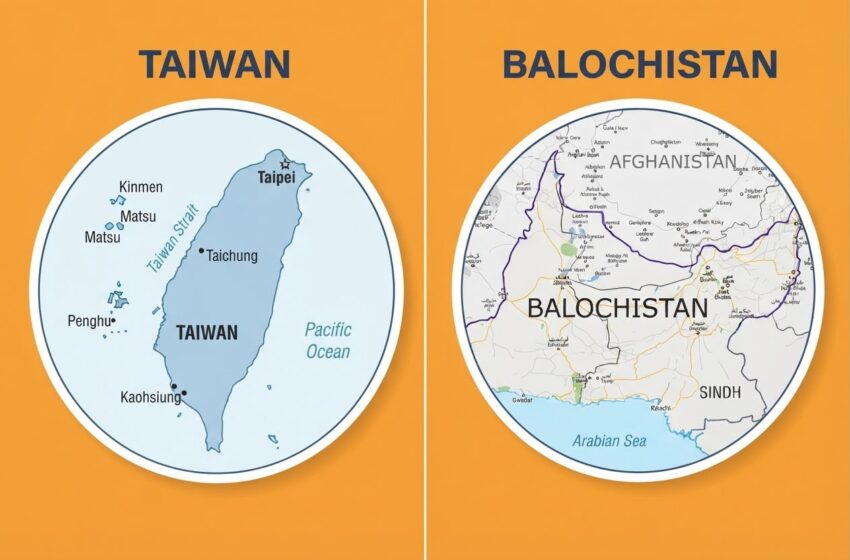
Balochistan and Taiwan: A History of National Independence, Global Politics and Resistance to Occupation
By Advocate Sadiq Raisani
The political history of the world demonstrates that powerful states have often sought to dominate smaller nations, languages and civilisations. Yet throughout history, many nations have struggled to preserve their identity, culture, homeland and aspirations for self-determination. The Baloch nation and the people of Taiwan are examples where questions of national identity and independence intersect with the political and military power of occupying states.
Balochistan is not merely a geographical region but a land with an ancient civilisation, distinct language, rich traditions and a long-standing sense of national identity. Throughout history, the Baloch people have maintained a distinct cultural and political presence. During the British colonial period, Balochistan occupied a unique constitutional position compared with many other regions of the Indian subcontinent. Agreements between the Khan of Kalat and the British government, including the Treaty of Kalat of 1876, recognised Kalat as a princely state under British influence while allowing it a significant degree of internal sovereignty.
Following the partition of British India in 1947, the Khanate of Kalat declared independence because members of the Kalat Assembly and the two houses opposed accession to Pakistan and advocated continued independence. According to the Baloch nationalist narrative, Pakistan annexed Balochistan in March 1948 under military pressure. The political resistance which emerged after 1948 continues today in various forms.
In the western part of Balochistan, which is commonly referred to by Baloch as Iranian-occupied Balochistan, decades of political, cultural and economic marginalisation by the Iranian state have reached their peak. The Iranian authorities have implemented strict security measures, restricted cultural and religious freedoms and pursued policies aimed at weakening Baloch identity. Like Pakistan, Iran has also been committing serious human rights violations, such as the occupation of Balochistan in 1928. Iran’s crimes against humanity include targeted killings, enforced disappearances, economic deprivation of Baloch youth and the ongoing executions of Baloch under trumped-up charges.
A comparable debate over national identity can be observed in Taiwan. Taiwan’s modern history has been shaped by colonial rule, civil war and competing claims of sovereignty. Japan occupied Taiwan following the First Sino-Japanese War in 1895. After World War II, administration of Taiwan was transferred to the Republic of China. In 1949, following the Chinese Civil War, the Nationalist government relocated to Taiwan after the Communist Party established control over mainland China.
Since then, Taiwan has developed its own democratic political system, highly advanced economy and internationally significant technology sector. It is home to some of the world’s leading semiconductor manufacturers and plays a critical role in global supply chains. Meanwhile, the People’s Republic of China continues to regard Taiwan as part of its territory and has stated that it reserves the option of using force to achieve unification.
The Taiwan issue extends beyond geography. It also involves questions of political sovereignty and national identity. Surveys conducted in Taiwan over many years have shown that many residents identify primarily as Taiwanese rather than Chinese. Many also support preserving Taiwan’s existing democratic political system, although views differ regarding formal independence and future relations with China. China’s military activities around Taiwan, including naval and air exercises, have heightened regional tensions.
Pakistan supports the ‘One China’ policy and does not recognise Taiwan as a sovereign state. Its close strategic partnership with China, including cooperation through the China-Pakistan Economic Corridor (CPEC), defence collaboration, and broader regional interests, has reinforced this position.
Baloch nationalist writers argue that if China bases its claim to Taiwan on historical grounds, then the Baloch people likewise possess historical, cultural and political claims to their homeland. They contend that national identity cannot be erased through military force and that history demonstrates coercion may suppress resistance temporarily but cannot permanently extinguish national consciousness.
History offers numerous examples of national movements seeking self-determination. Algeria secured independence following a prolonged war against French colonial rule. East Timor gained independence after years of Indonesian occupation and international intervention. South Sudan became an independent state after decades of armed conflict. Meanwhile, the Kurdish nation continues to pursue varying degrees of political recognition and autonomy across Turkey, Iran, Iraq, and Syria.
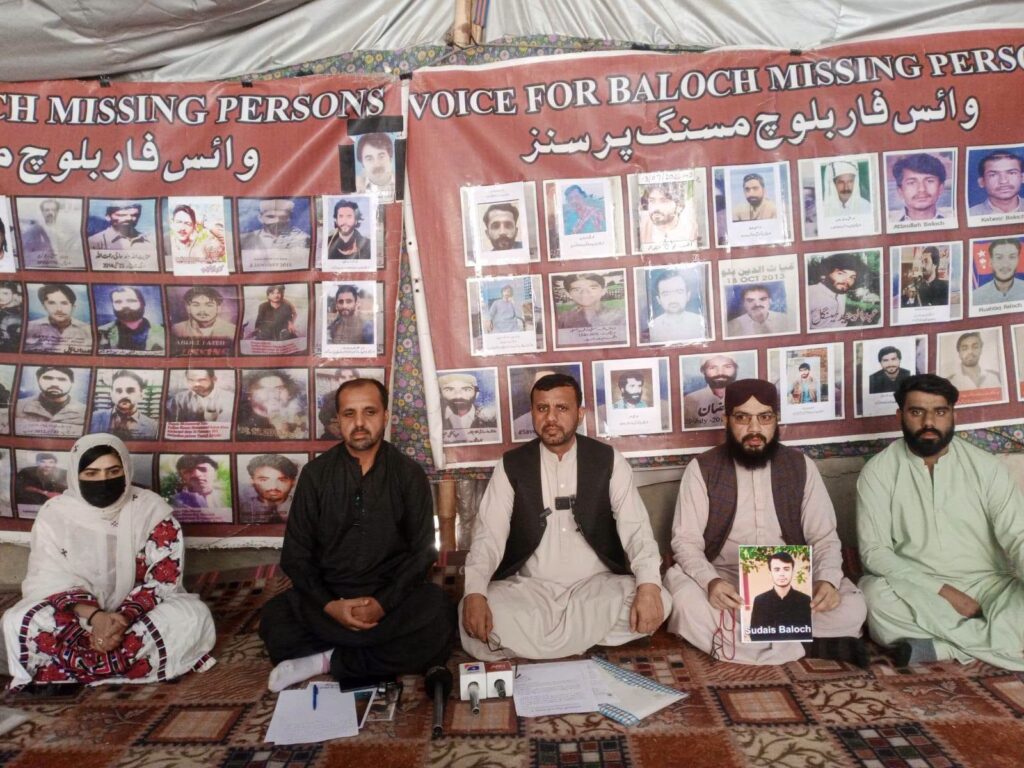
In Balochistan, international human rights organisations, including the UN Working Groups on Enforced Disappearances, have documented allegations of enforced disappearances, arbitrary detentions and restrictions on civil liberties over many years. Baloch political activists, lawyers, journalists, students and academics have repeatedly argued that the conflict cannot be resolved solely through security measures but requires a political solution addressing longstanding grievances.
Similarly, China’s policy toward Taiwan is viewed by many analysts as involving not only military considerations but also competing political and ideological visions. Beijing emphasises national unity and territorial integrity, while Taiwan’s government maintains its separate political system and democratic institutions. The United States and several other countries play significant roles in cross-Strait relations due to Taiwan’s strategic importance in global technology and Indo-Pacific security.
Although Balochistan and Taiwan differ significantly in their historical backgrounds, legal status and international recognition, both raise broader questions concerning national identity, political legitimacy and self-rule. In both cases, competing narratives reflect differing interpretations of history, sovereignty and international law.
In today’s world, military power alone is rarely sufficient to resolve complex political disputes. Human rights, international law, public opinion and democratic values have become increasingly influential in shaping global politics. Consequently, both the Baloch issue and the Taiwan dispute continue to generate international political and moral debate.
History often remembers those nations that strive to preserve their identity and political aspirations. While military power may secure temporary control, it cannot by itself resolve questions of identity or national consciousness. For many observers, the experiences of the Baloch people and the people of Taiwan illustrate the enduring significance of freedom, identity and national sovereignty in contemporary international politics.
About the Author: Sadiq Raisani is a lawyer, political activist and Head of the Tribal Affairs Department of the Free Balochistan Movement (FBM).
Disclaimer: The views and opinions expressed in this article are solely those of the author and do not necessarily reflect the official policy or position of Baloch Warna News. The publication provides a platform for diverse perspectives.