Dr Mahrang Baloch: A Beacon of Resistance, Perseverance and Hope
By Behroz Baloch
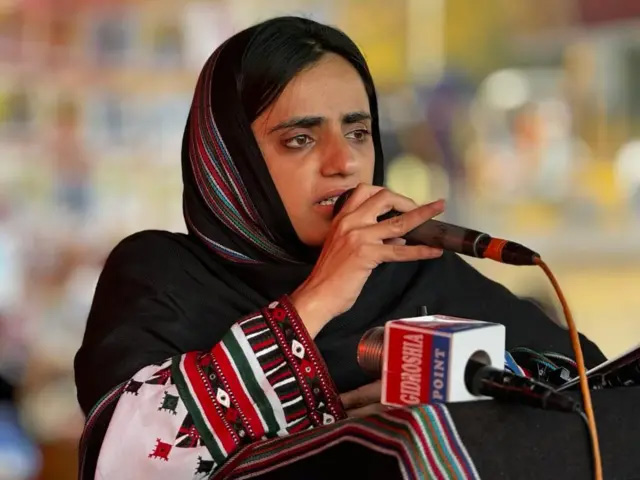
In Balochistan’s political and human rights history, Dr Mahrang Baloch has emerged as a prominent voice who, despite fear, pressure, and imprisonment, has refused to back down from her stated position. A doctor by profession and a prominent organiser of the Baloch Yakjehti Committee (BYC), she has consistently raised her voice against enforced disappearances, extrajudicial killings, and violations of the fundamental rights of the people of Balochistan.
Mahrang Baloch’s struggle is not merely a political slogan; it is deeply rooted in her personal experiences and the circumstances of Balochistan. Her father was also imprisoned in connection with his involvement in the Baloch rights movement. Mahrang later chose to continue this path herself, raising her voice for her people’s rights.
Under her leadership, and with the participation of other activists, Baloch women and young people have taken part in protests, long marches, and sit-ins in an effort to bring their demands before the country and the international community. The Baloch Long March of 2023 was one of the most significant moments in this struggle.
On March 22, 2025, Dr Mahrang Baloch was arrested during a protest in Quetta. She subsequently faced multiple charges, including terrorism-related allegations. Mahrang and her supporters rejected these allegations and described their movement as a peaceful struggle for rights.
For her, imprisonment was not simply a physical restriction; it also represented an attempt to limit her public voice. Yet letters and statements attributed to her during her detention reflected her continued commitment to the cause she had publicly advocated. In messages from prison, she expressed her determination to endure hardship and continue her struggle for the rights of the Baloch people.
A central aspect of Dr. Mahrang Baloch’s public activism has been her stated commitment to peaceful political advocacy. She has repeatedly spoken about enforced disappearances, human rights concerns, and political freedoms. She and the BYC have described their movement as a struggle to pursue rights through constitutional and peaceful political means. She has also publicly expressed opposition to state violence in Balochistan.
This steadfastness has become an important part of her public image. Circumstances have changed, allegations have been brought against her, and she has faced imprisonment, yet the issues she has highlighted—human dignity, justice, peace, and fundamental rights—have remained at the centre of her public activism.
On June 22, 2026, an Anti-Terrorism Court in Quetta sentenced Dr. Mahrang Baloch and BYC leader Sibghatullah Shah Ji to life imprisonment in a case concerning the death of a Frontier Corps official during the 2024 Baloch Raaji Muchi gathering in Gwadar. According to reports on the case, the prosecution alleged that the accused had incited violence and that the death occurred during unrest at the gathering. Mahrang Baloch and her co-accused denied the allegations.
Human rights groups and Mahrang Baloch’s supporters have raised serious concerns about the proceedings, while government officials have defended the verdict as the outcome of a judicial process. Her legal team challenged the conviction, and on July 16, 2026, the Balochistan High Court admitted her petition for regular hearing and issued notices to the relevant respondents.
It is therefore important to maintain a clear distinction between the prosecution’s allegations and the position of Mahrang Baloch and her supporters, who reject the charges and describe their movement as a peaceful, rights-based struggle.
One of the most notable aspects of Mahrang Baloch’s public role is the prominence she has given to Baloch women as active participants in political and social movements, rather than merely as victims of circumstances. Her public presence has encouraged many Baloch women and young people to believe that it is possible to raise one’s voice, ask questions, and peacefully advocate for fundamental rights.
In this sense, she has become a symbol to many of her supporters of the idea that leadership is not simply about power or official position. At times, leadership means standing firmly by one’s principles in the most difficult circumstances.
The story of Dr. Mahrang Baloch is not simply the story of one individual. It has become part of a much broader and more complex debate surrounding rights, identity, justice, enforced disappearances, and political freedoms in Balochistan.
Her supporters regard her as a symbol of resistance and hope, while the state has brought serious allegations against her. As a result, public views of her role differ sharply. Nevertheless, her activism has brought issues concerning Balochistan greater national and international attention.
The story of Dr. Mahrang Baloch reflects how political and social questions can continue to resonate even when an individual faces imprisonment and severe pressure. Her supporters see her perseverance as evidence that difficult circumstances do not necessarily silence demands for dignity, justice, peace, and rights.
For many Baloch youth and women, Mahrang Baloch has become a symbol of courage, perseverance, and peaceful political advocacy. Her story remains closely connected to the wider and ongoing debate over the rights, grievances, and political future of Balochistan.