27 March Balochistan Occupation Day: Free Balochistan Movement Held events and protests
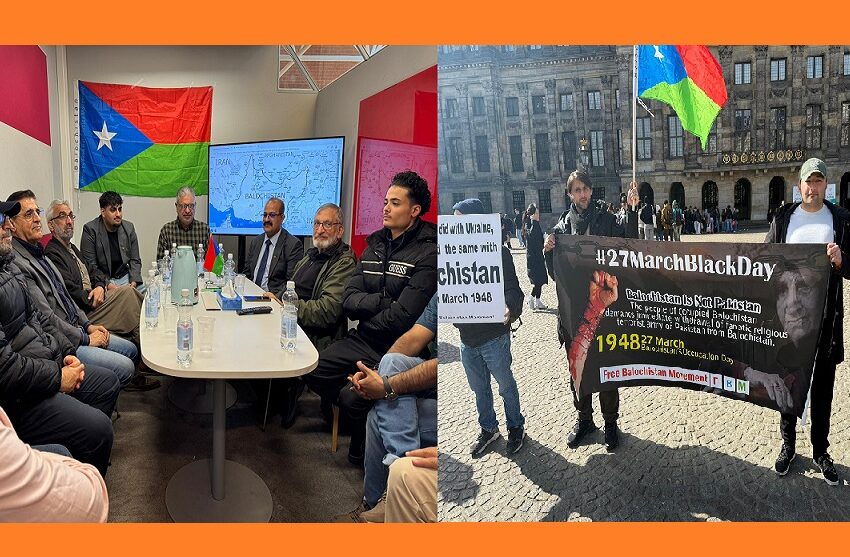
Helsinki / Amsterdam: The Free Balochistan Movement held events in Helsinki, Finland, and Amsterdam, the Netherlands, on March 27 to mark the date and protest the forced occupation of Balochistan.
In Helsinki, a program took place featuring political leaders, activists, and human rights supporters. Speakers discussed the situation in Balochistan, including the idea of an independent “United Balochistan,” the challenges faced by the Baloch people and the ongoing Pakistan and Iranian state repression.
Among those who spoke were Advocate Sadiq Raisani, M.B. Marri Baloch, Dr. Samuel Baloch, Ali Gul Baloch, Dr. Nohan Baloch and Mehran Marri Baloch, organiser of the Finland branch of the Free Balochistan Movement.
They said that March 27 is one of the darkest days in Baloch history. According to them, it marks the time when Pakistan forcibly occupied the sovereign state of Balochistan and illegally annexed it.
Speakers at the Helsinki event said that people in Balochistan are being denied basic human rights since the forced occupation of Balochistan. They said that state pressure is increasing and that serious abuses are taking place. These include extrajudicial killings, enforced disappearances, military operations and collective punishment. They also said that thousands of young Baloch men have been killed or have gone missing without legal process, and that their families are still seeking justice.
The speakers added that Baloch women suffer the Occupying state repression and brutalities as women activists are often harassed, arrested and illegally imprisoned. The Baloch women are subjected to both mental and physical abuses, which they described as serious human rights violations.
Leaders from the Pashtun Tahafuz Movement (PTM), including Shafiullah Yousafzai, Abdul Bari Barech, and General Faizullah Kochi, also attended the FBM event and spoke about the historical relationship between the Baloch and Afghan people. They said both nations have been connected for centuries and that unity and joint efforts are important in the current situation.
Other speakers, including Waja Ibrahim Baloch and Mustafa, an Iraqi youth, said that the situation in Balochistan is a test for the international community. They called on the United Nations and global human rights organisations to take notice and help ensure justice for the Baloch people.
At the same time, the Free Balochistan Movement Netherlands Branch held a protest demonstration in Amsterdam at Dam Square, one of the busiest locations in the city.
Organisers said the purpose of the protest was to inform the international community about the historical and current situation in Balochistan. Participants held banners and placards calling for Balochistan’s independence and the restoration of human rights.
Obaidullah Baloch, a senior member of the movement, said in his speech that March 27, 1948, was the day when Balochistan’s sovereignty ended and the region was taken over by force. He said this happened against the will of the Baloch people.
Baloch activist Dr. Abdul Latif Baloch also described March 27 as a dark day in Baloch history. He said that Balochistan was an independent state before being annexed to Pakistan, and claimed that control has since been maintained through force. He further said that serious human rights violations against the Baloch population have been a routine practice of Pakistani forces.
Speakers at the Amsterdam protest also called on the Dutch government and the European Union to respond to the situation and to address the ongoing violations in Balochistan.
The demonstration in Amsterdam ended peacefully, with participants reaffirming their commitment to continue their political efforts at the international level.
Meanwhile, in Helsinki, participants paid tribute to Baloch martyrs and repeated their commitment to continue raising their voices for the freedom of Balochistan, as well as the protection of Baloch identity, language, land and history.