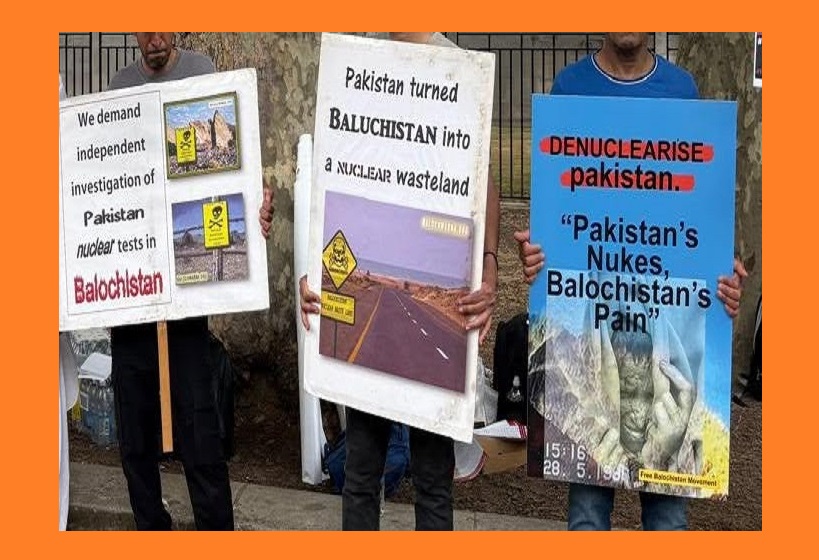
The Human Cost of Nuclear Activities in Dera Ghazi Khan and Chaghi
By Umar Baloch
Over the years, residents of Dera Ghazi Khan and nearby regions of Balochistan have increasingly expressed concern over the rising number of cancer cases and other chronic illnesses. Several doctors and local medical practitioners have also raised concerns about the reportedly higher prevalence of cancer in Dera Ghazi Khan and the tribal areas of the Sulaiman mountain range compared with many other parts of Balochistan. Many local communities and healthcare professionals believe these health problems are linked to prolonged uranium mining activities, the improper disposal of radioactive waste and the long-term environmental impacts of nuclear-related operations in the region.
The local population of Chaghi District, where Pakistan conducted its nuclear tests, has consistently raised concerns that the long-term effects of nuclear testing, radiation exposure, and the improper handling of radioactive waste have adversely affected local communities. Residents argue that people in the region have continued to suffer economically, environmentally and physically, particularly through the growing burden of chronic illnesses and cancer-related diseases.
The tribal areas of Dera Ghazi Khan, located in the highlands of the Sulaiman mountain range, are rich in natural resources, including natural gas, oil, and radioactive minerals such as uranium. Uranium deposits in the region were discovered during the 1960s, after which the Pakistan Atomic Energy Commission (PAEC) began uranium mining operations in the Baghalchur area in 1977. Over time, eight nuclear-related plants and facilities were established only a few kilometres from human settlements.
Baghalchur, situated nearly 40 kilometres northwest of Dera Ghazi Khan, is home to approximately 15,000 people who continue to live with limited healthcare and educational facilities. Residents often point out that despite decades of uranium extraction, the area still lacks basic development. Residents say there is only one primary school in the area, located close to a nuclear waste dumping site, raising concerns about long-term exposure to radioactive materials.
Community members and local activists also allege that three major nuclear waste dumping sites spread across more than 1,000 acres exist in the region. They argue that many of these sites are poorly regulated and do not fully comply with international nuclear safety standards. Residents further report the presence of abandoned military-style barrels believed to contain radioactive waste. Several former uranium mines have reportedly become submerged by rainwater over the years, increasing fears of environmental contamination and groundwater pollution.
In an interview with the Herald, a senior Baghalchur resident, Lal Muhammad, stated that since 1999, abandoned mines in the area have been used as dumping sites for nuclear waste. Concerns among local communities reportedly intensified after 2015, when PAEC expanded nuclear-related facilities and activities in the region.
Pakistan conducted its nuclear tests in Chagai District, Balochistan, on 28 May 1998. Reports indicated that the surrounding area was inhabited by local communities. Residents and activists argue that the tests affected local livelihoods, environmental conditions and public health and that the consequences continue to be felt today.
Reports from Dera Ghazi Khan and other parts of Balochistan indicate a rise in several forms of cancer, including lung, liver, blood, bone marrow, throat and skin cancers, as well as kidney-related diseases. Concerns have also been raised about increasing rates of chronic illnesses in Chaghi and Kharan districts.
During a visit to affected areas of Dera Ghazi Khan in 2015, Herald reported cases of malnutrition, vision impairment, and unusual physical growths among both humans and livestock. Lal Muhammad Buzdar told the publication that health problems among people and animals had increased significantly due to what he described as radiation exposure.
Residents of Baghalchur have also highlighted the lack of adequate water, healthcare, and educational facilities in the area while expressing concern about the proximity of schools and residential settlements to nuclear waste dumping sites.
The nuclear tests conducted in Chagai in May 1998, along with ongoing nuclear-related activities in Dera Ghazi Khan, are believed by local residents and activists to have caused serious environmental consequences. These include groundwater contamination, soil degradation, adverse effects on agriculture and livestock, and the long-term persistence of radioactive materials in the environment.
Uranium-238 and radon levels have reportedly been found above recommended safety limits in parts of Dera Ghazi Khan, particularly in Taunsa Tehsil, raising concerns about long-term health risks, including lung cancer associated with prolonged exposure to radioactive dust.
People living in Baghalchur and the highlands of Koh-e-Sulaiman have also expressed concern about the contamination of natural springs and rain-fed streams that flow near radioactive waste dumping sites.
According to a study examining the physicochemical and microbial characteristics of water sources in Koh-e-Sulaiman and Dera Ghazi Khan, several water samples collected from different locations were deemed unsafe for human consumption. Several doctors have also reported that cancer rates and other diseases in these regions appear significantly higher than in many other parts of the country.
In 2021, Dr. Hidayat, a gastroenterologist at the District Headquarters Hospital in Dera Ghazi Khan, stated that a possible factor contributing to rising cancer and liver disease cases was the use of water potentially contaminated by uranium in villages located near mining areas.
Environmental degradation in the affected regions has impacted not only humans but also livestock. Residents told the Herald that livestock deaths have increased substantially over the years, raising concerns about the long-term environmental and radioactive impact on local communities and their livelihoods.
Federal institutions and nuclear authorities of Pakistan have always denied the harmful effects caused by uranium mining and radioactive waste dumping sites, despite several studies, reports, and concerns raised by local residents and doctors pointing towards the opposite.
In 2005, residents of Baghalchur filed a court case against the dumping of nuclear waste in the Koh-e-Sulaiman mountains. Following the petition, the Supreme Court of Pakistan directed PAEC to submit a report on the matter. However, residents argue that no significant progress has been made since then.
Activists associated with Baloch Raj and Buzdar Ittihad, a local organisation, have alleged that they were threatened and pressured to halt campaigns highlighting radiation exposure and environmental contamination. Some activists reportedly received summons from police authorities. They argue that concerns raised in the name of environmental protection and public health have often been suppressed under the pretext of national security.
According to a study published in 2022 by Saira Bano and her colleagues, cancer was found to be highly prevalent in Dera Ghazi Khan, particularly in the tribal areas. The researchers concluded that their findings supported local perceptions that radioactive elements may be a significant factor contributing to cancer incidence in the region. The study also noted an unexpectedly high number of cancer cases among younger age groups. Among the district’s three tehsils, the tribal area recorded the highest prevalence despite having the smallest population.
Many Baloch political activists argue that Pakistan has historically treated Balochistan as a colony while prioritising strategic, military and economic interests over the welfare of local residents and the Baloch nation over all. Pakistan commemorates 28 May as “Youm-e-Takbeer” (Day of Greatness), marking its nuclear tests, while many Baloch people remember the date as “Yum-e-Aasrokh,” meaning the day of fire and destruction.
Critics argue that following the tests, inadequate measures were taken to assess or mitigate radioactive impacts and that international experts were not given sufficient access to conduct independent studies. They contend that local communities have continued to bear the economic, physical and psychological consequences of nuclear activities.
Reports of cancer cases and skin diseases from various regions of Balochistan—including Chaghi, Kharan, Awaran, Khuzdar, and Dera Ghazi Khan—frequently appear on social media and in local discussions. Observers believe the actual number of cases may be significantly higher because of underreporting, limited awareness, inadequate diagnostic facilities and the absence of specialised cancer treatment centres in many areas. Even those who receive a diagnosis often struggle to access or afford proper treatment.
How long will Pakistan continue to escape accountability while the people of Balochistan are left to suffer in silence? How many more lives must be destroyed before the world demands transparency, justice, and independent investigation? A state cannot continue to hide behind the name of national security while ignoring the pain, fear, and suffering of the Baloch Nation.
This is not only killing people in the present but is also affecting generations of Baloch people for years to come. Pakistan’s nuclear program has not only affected the Baloch people and Balochistan but also poses a serious global security threat, raising questions about whether these nuclear weapons are really safe in such a destabilised, unreliable and religiously extremist country. Moreover, Pakistani nuclear scientist Dr. Qadeer Khan admitted to passing nuclear secret information to other states.
The Baloch people demand a free and fair investigation into Pakistan’s nuclear tests conducted in Balochistan. We demand the denuclearisation of Pakistan and independent studies regarding the effects of nuclear radiation in Dera Ghazi Khan and the tribal areas.
Disclaimer: The views and opinions expressed in this article are solely those of the author and do not necessarily reflect the official policy or position of Baloch Warna News. The publication provides a platform for diverse perspectives.